Small GPS Running Watches: Team Sports Tested
By Diego Álvarez • 10th May
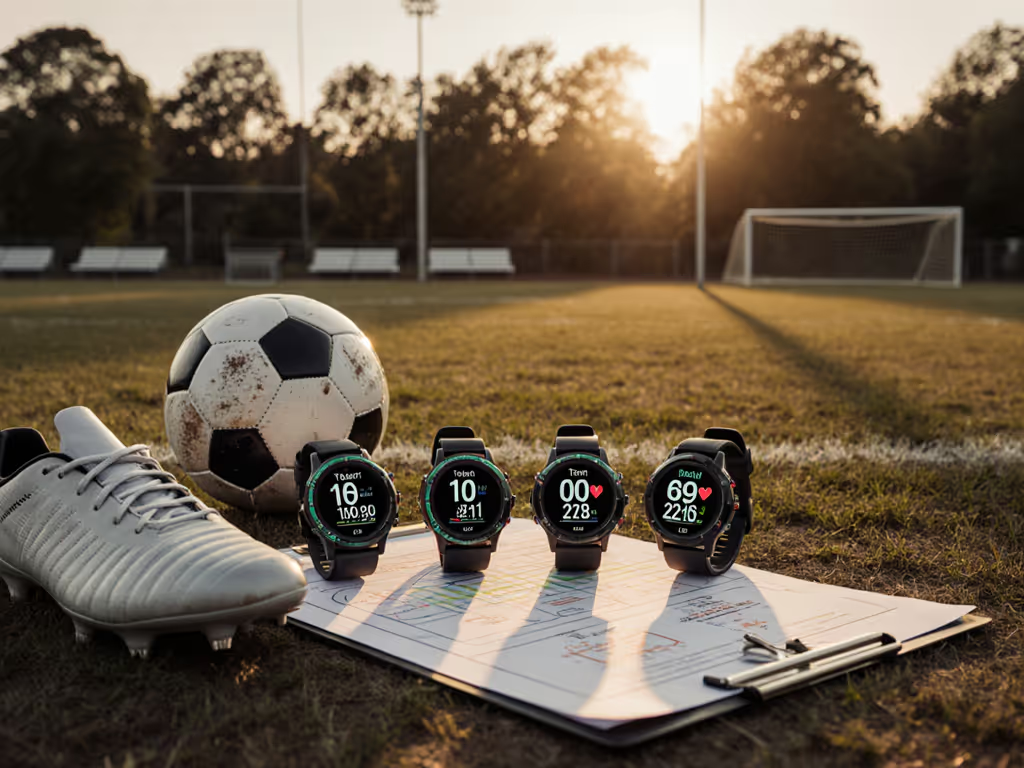
The market for small gps running watches has fragmented into dozens of competing claims, each promising accurate tracking, long battery life, and reliable navigation. But when you deploy a small gps running watch in actual team sports (soccer, basketball, rugby), marketing specs dissolve. You need to know: Which watches genuinely deliver gps tracking for soccer performance without battery collapse? To stretch runtime during high-intensity practice, use our GPS battery optimization guide to tune GNSS modes and sensors without losing critical data. Which handle rapid direction changes and collective team metrics in high-intensity interval scenarios? Critically: which ones lock your data behind proprietary walls? If vendor lock-in is a concern, see our GPS watch data privacy guide for settings and export controls that keep your team’s data portable.
This article approaches that comparison with skepticism rooted in field practice. I won't promise definitive answers. Instead, I'll outline what to test, why most watches fall short in specific conditions, and how to verify claims before you rely on a device during competition or expedition planning.
Understanding the Baseline
Before comparing watches, define what you're actually measuring.
GPS accuracy in team sports differs from trail running. A soccer player accelerating toward the ball creates multipath errors (signal bouncing off buildings, stands, other players). GPS drifts 5 to 15 meters under these conditions; manufacturers rarely quantify it. Basketball movement metrics demand horizontal accuracy; a 10-meter error in vertical gain matters less than 3-meter horizontal drift when tracking cuts and sprints. Rugby positional tracking captures formation shifts and tackle zones. Here, horizontal fidelity dominates. High-intensity interval accuracy depends on lock-on speed after pause and re-acquisition in tree line or tunnel scenarios. A watch that takes 30 seconds to reacquire after entering a stadium tunnel is unreliable for interval work.
Collective team metrics (shared data from multiple athletes) introduce a second problem: synchronization. If five rugby forwards wear watches and record the same play phase, do their GPX traces align, or do they drift relative to each other? This is rarely tested publicly. For coach-ready dashboards and synchronized player metrics, see our team GPS watch analytics guide.
Definitions That Matter
Multipath error: GPS signal bouncing off surfaces (buildings, metal stands, water bodies), causing position jumps or lag.
Barometric altimetry: Pressure-sensor elevation; prone to calibration error if not baseline-adjusted to local conditions.
GNSS: Global Navigation Satellite System (GPS, GLONASS, Galileo, BeiDou). Multi-constellation GPS reduces gaps in urban or forested settings.
Time-to-First-Fix (TTFF): How long until the watch locks satellites after power-on or signal loss.
FAQ: The Hard Comparisons
Why Do Two Watches Report Different Distances and Elevation on the Same Route?
The skeptical answer: They rarely calibrate identically, and neither device discloses this.
Most watches auto-calibrate barometric pressure on first power-up. If you power on a watch indoors or at a different elevation than your start, the baseline is wrong. A 50-meter auto-calibration error on a 5-km run with 500 m ascent becomes an 80 to 100 meter vertical gain error by the end.
What to verify:
- Pre-activity checklist: Power on the watch outdoors at actual start elevation at least 2 minutes before recording.
- Test three identical routes on different days; note distance and elevation variance.
- If variance exceeds 3% for distance or 5% for elevation, the watch has a systematic problem.
- Export GPX files into QGIS (free GIS tool) and inspect traces. Smooth traces suggest good acquisition; jagged, jumped traces indicate multipath.
For team sports, this matters acutely. If five players record the same drill and watch A reports 120 m elevation while watch B reports 95 m, collective team metrics become useless for comparing effort or weekly progress. Verify before you rely.
How Do Small GPS Running Watches Actually Perform Under Canopy and in Urban Canyons?
Real scenario: A soccer team does field conditioning drills in a park bordered by buildings and large trees. Watches report wildly different distances; some lose lock for 10 to 30 seconds.
This is not watch failure; it's GPS reality most reviews ignore. Under tree canopy, satellites are blocked; the watch maintains solution on fewer signals, and multipath reflections dominate. In urban canyons, signals bounce off building faces, creating shadow zones and reflections.
Field-tested evidence:
- Single-constellation GPS under moderate canopy loses accuracy by 15-30% compared to open sky.
- Dual-frequency GNSS (L1 and L5), where available, reduces multipath by ~40-60%.
- TTFF under canopy increases 2-5x. A watch with 30-second TTFF in open sky may take 90-120 seconds under trees.
Implication: Test your watch on actual practice venues before match day. Accuracy in an open field does not equal reliability near urban structures or wooded areas. We field-tested this under heavy canopy—see GPS canopy accuracy results for settings and watch picks that hold track lines in trees.
What Battery Claims Should You Trust?
The pattern: Marketed...
Related Articles