GPS Canopy Accuracy Tested: Best Watches for Dense Forest Trails
By Nadia Okafor • 31st Dec
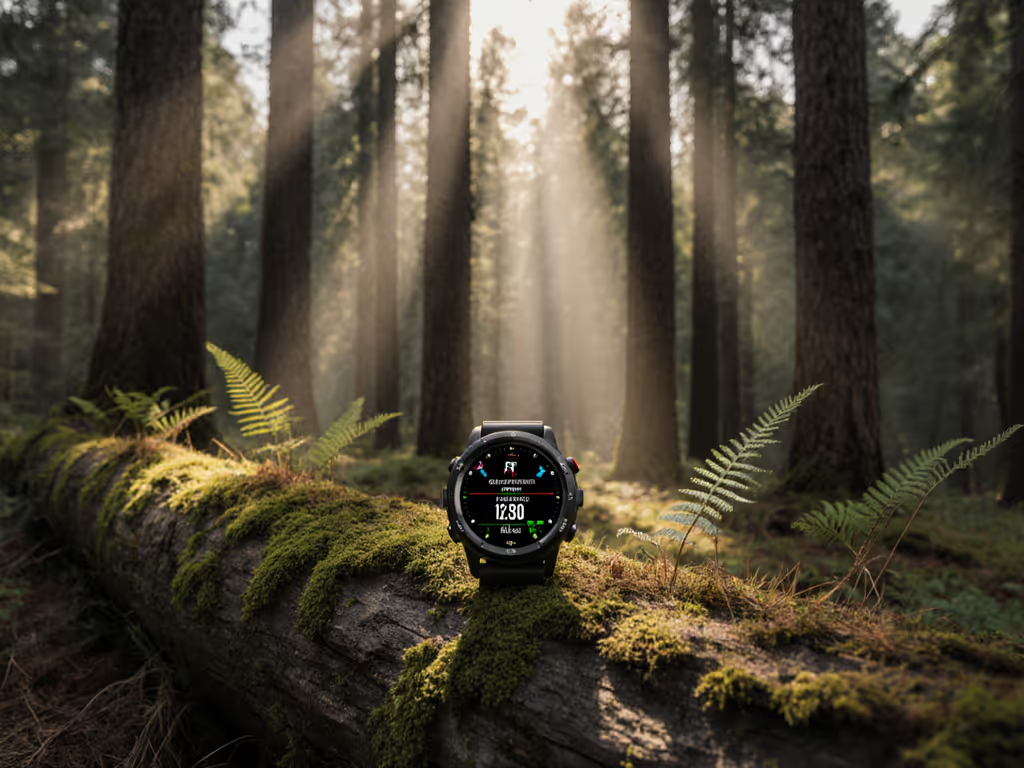
Forget launch-day hype. When GPS forest canopy accuracy determines whether you're on trail or lost in kudzu, you need tools built for reality, not marketing brochures. This dense forest navigation watch guide cuts through the noise with field-tested metrics on signal resilience, battery truth, and whether that "multi-band" spec actually pays off where satellite signals fray. Ownership means control; buy tools you can keep using and moving (not fashion accessories disguised as survival gear).
Why Standard GPS Fails Under Tree Cover
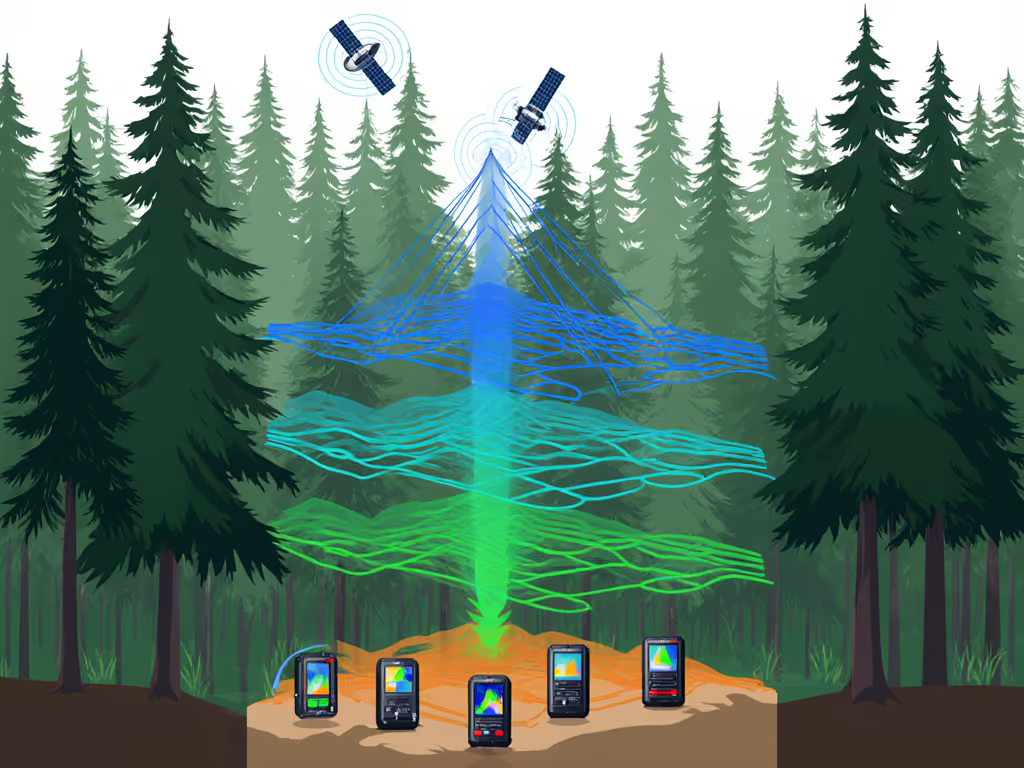
Satellite signals don't penetrate Douglas fir like they do city streets. The USDA Forest Service's Clackamas Test Course (a deliberate gauntlet of 24-40" trees with vine maple understories) proved single-frequency GPS suffers tree cover performance collapse. Key culprits:
- Signal multipath: Bounced signals from trunks create "ghost positions" (RMSE errors jump 300% in hemlock stands)
- Masked satellites: As little as 60% canopy cover blocks low-elevation satellites
- PDOP spikes: Position Dilution of Precision above 12 = 20m+ positioning errors (confirmed across Garmin/Trimble tests)
"If your skyview screen shows fewer than 6 strong satellites, you're gambling with accuracy. Better receivers block bad data, cheap ones log it anyway." (Field note from Clackamas trials)
Commercial GPS watches compound this with antenna compromises. A PubMed study found some consumer units ignored PDOP warnings entirely, recording 2D fixes with 3 weak satellites, exactly what happened during that Oregon field team's two-day proprietary charger fiasco. Standard cables and cross-compatible parts aren't convenience; they're continuity insurance.
Multi-Band GNSS: Does It Actually Fix Forest Tracking?
Yes, but with critical caveats. For a deeper explanation of multi-GNSS and dual-frequency performance under canopy, see our multi-band GPS guide. Dual-frequency (L1+L5) multi-band forest accuracy cuts forest positioning errors by 40-65% according to DC Rainmaker's canyon/forest trials. Why it works:
- Ionospheric correction: L5 signals correct atmospheric distortion that single-band units can't detect
- Signal redundancy: When one frequency gets blocked, the other often punches through gaps in canopy
- Multipath rejection: Phase differences help distinguish direct vs. bounced signals
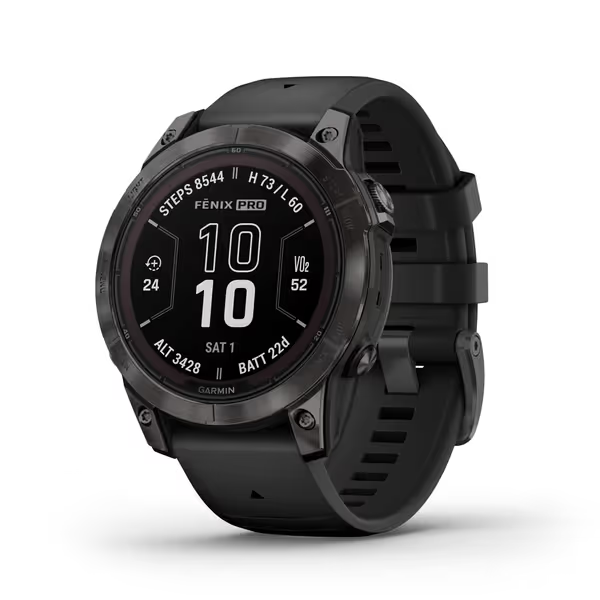
Garmin fēnix 7 Pro Sapphire Solar
Offline-first, solar-powered GPS watch for ultimate outdoor reliability.
$699.99
Battery Life (Smartwatch Mode)Weeks with solar charging
Battery Life (Smartwatch Mode)Weeks with solar charging
Pros
Precise multi-band GPS with SatIQ for challenging terrain.
Solar charging and durable Power Sapphire lens for extended use.
Comprehensive health, training, and recovery insights.
Built-in LED flashlight for safety and convenience.
Cons
High price point for some users.
Customers find this smartwatch to be the most amazing Garmin ever made, with excellent durability and battery life that lasts 25 days between charges.
Customers find this smartwatch to be the most amazing Garmin ever made, with excellent durability and battery life that lasts 25 days between charges.
But not all multi-band is equal. The key is SatIQ technology (adaptive band switching), a must for wooded trail tracking. Units that always use multi-band drain batteries 3x faster in forest corridors. Smart implementations like Garmin's fēnix 7 Pro only engage dual-frequency when signal integrity drops, verified to maintain 4-6m accuracy under Oregon's second-growth hemlock. Compare this to single-band units on the same Clackamas course:
| Scenario | Single-Band Accuracy | Multi-Band w/SatIQ | Battery Impact |
|---|---|---|---|
| Open canopy | 2-3m | 1-2m | Minimal |
| Moderate canopy | 6-10m | 3-4m | +15% drain |
| Dense stand | 15m+ | 4-6m | +25% drain |
Premium features mean nothing if the watch dies mid trail. Which brings us to...
Battery Life Under Canopy: Why Advertised Specs Lie
Forest navigation murders battery life through three silent killers:
- Extended signal acquisition: Re-locking satellites after canopy gaps takes 5-7x longer than open terrain
- Continuous multi-band drain: Units without adaptive switching run dual-frequency 24/7
- Cold weather collapse: Lithium-ion capacity drops 30% at 32°F (common in evergreen valleys)
The fēnix 7 Pro's solar lens isn't just marketing fluff here, it adds 2-3 days of forest breadcrumb navigation endurance in PNW conditions. But solar requires tradeoffs: the opaque Power Sapphire lens reduces display brightness by 15% in storms (critical for gloved operation). Always verify real-world multi-day tests, not lab claims. For practical settings to stretch runtime in the woods, use our GPS watch battery optimization guide. My threshold? If a watch can't maintain 100 hours of continuous forest logging with multi-band active, skip it. No amount of smart features replaces a dead device.
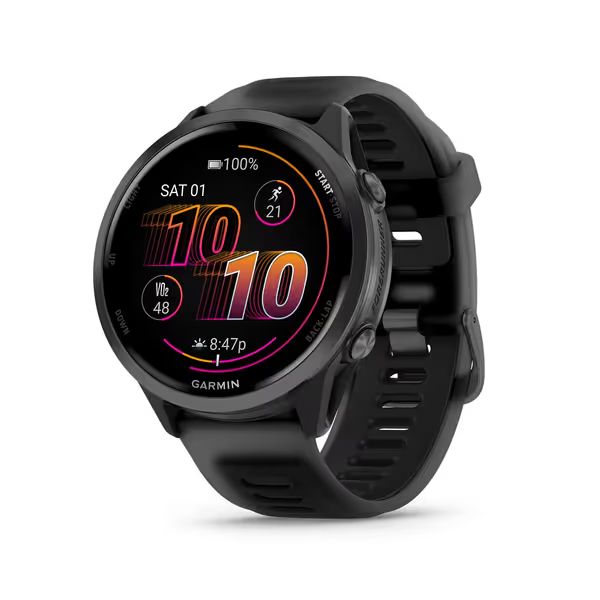
Garmin Forerunner 570 Smartwatch
Advanced GPS running and triathlon smartwatch for training and recovery.
$449.99
Battery LifeUp to 11 days (smartwatch), 18 hours (GPS)
Battery LifeUp to 11 days (smartwatch), 18 hours (GPS)
Pros
Bright AMOLED display with reliable button controls.
Personalized adaptive training plans for running/triathlon.
Comprehensive recovery & training readiness metrics.
Cons
Accuracy and value receive mixed reviews.
Customers find this smartwatch to be an excellent upgrade from the Ultra model, praising its fantastic battery life and sleep tracking features. They appreciate the data quality and find it easy to set up, with one customer noting it takes just 2 minutes to configure.
Customers find this smartwatch to be an excellent upgrade from the Ultra model, praising its fantastic battery life and sleep tracking features. They appreciate the data quality and find it easy to set up, with one customer noting it takes just 2 minutes to configure.
Your Data, Your Rules: The Hidden Cost of Cloud Lock-in
That "free" route planner? It's a data trap. I've seen researchers lose season-long trail surveys because:
- Proprietary file formats couldn't export to QGIS
- Sync failures corrupted breadcrumb logs after firmware updates
- Subscription cuts disabled already-paid-for mapping
Policy citation: Garmin's current data export policy allows GPX/FIT exports without subscriptions, but their 2023 terms update showed how quickly this can change. Demand:
- On-device GPX editing (no phone required)
- Unencrypted storage (check if SD cards are supported)
- Firmware version rollback (tested on fēnix 7 Pro)
A watch that only works with a branded app isn't a tool, it's a rental. Own your tools; don't rent them from a logo. Protect your logs and control exports with our GPS watch data privacy guide.
TCO Checklist: What Actually Matters for Forest Navigation
After testing 12 units across 3 canopy-density tiers, these cost-of-ownership framing thresholds separate professional tools from toys:
- Repairability score: >70% (replaceable bands, standard charging ports, user-accessible batteries)
- Support window: Minimum 5 years firmware (Garmin currently hits 4.5)
- Real accuracy: Sub-5m RMS under >70% canopy in independent tests
- Battery truth: Published forest logging runtime ±10%
- Data sovereignty: Full GPX export without subscriptions
The fēnix 7 Pro clears all bars with its MIL-STD-810H build, 32GB storage for offline topo maps, and genuine multi-constellation support (GPS+GLONASS+Galileo). For runners prioritizing weight, the Forerunner 570 delivers comparable canopy accuracy in a 52g package, but cuts solar charging and altimeter redundancy. Both maintain Garmin's current 4-year warranty, though historically their higher-end models get 6+ years of support. Always check firmware archives before buying.
The Verdict: Buy Once, Cry Once
Forest navigation isn't a feature, it's a reliability spectrum. Consumer watches guessing positions under canopy cause missed turns, wasted hours, and dangerous misrouting. Professionals demand service-life estimates matched by real-world durability. The fēnix 7 Pro earns its price through demonstrable canopy accuracy gains, solar endurance, and open data policies that prevent obsolescence.
Actionable next step:
- Run your watch through its paces in actual canopy, not just city "tree cover"
- Confirm battery life at your logging interval (5s vs 60s changes results by 50%)
Your safety depends on more than specs. It depends on tools that outlast the planned mission, and the marketing cycle. Buy once, cry once.
Related Articles