Safety-Grade GPS Watches for Professional Guides
By Marta Kovács • 1st Jan
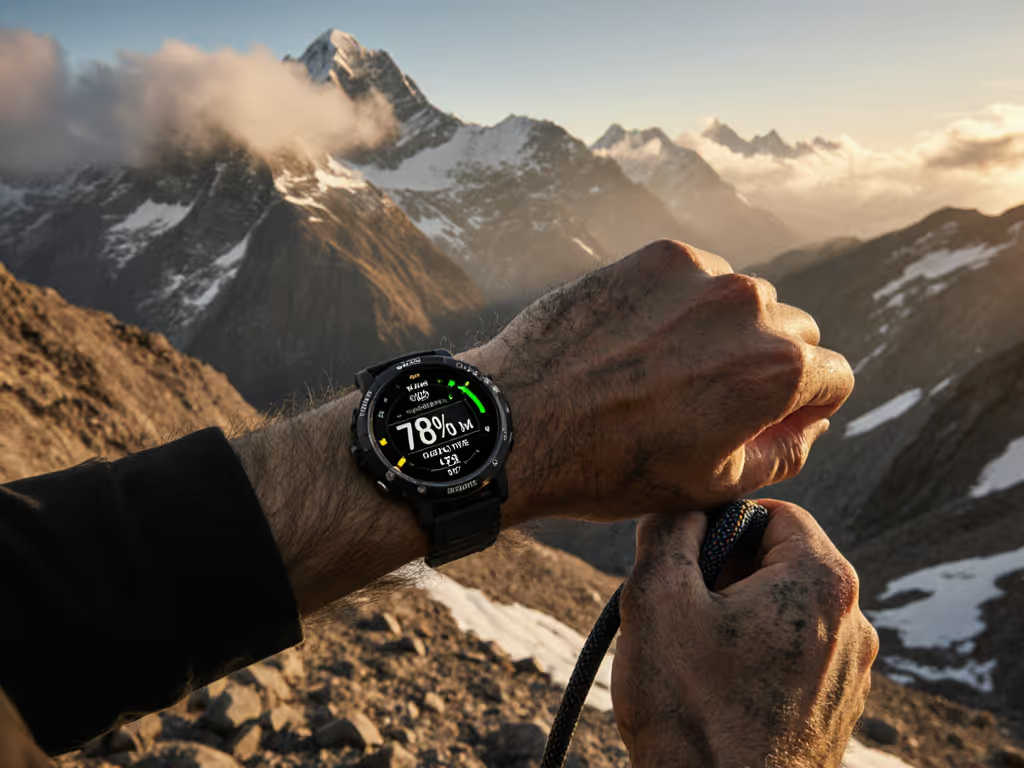
When your clients' lives depend on navigational certainty, you don't want a gps watch for professional guides that merely tracks you, you need one that saves you. After years testing gear in the Himalayas and Andes, I've learned that a true outdoor guide navigation watch isn't about flashy metrics: it's about surviving the moment when your backup power fails and your team's safety hinges on precise coordinates at -20°C. Batteries lie; logs don't. Budget before you boot, always. This isn't about comfort: it is about engineered endurance that lets you navigate out when others are guessing. Let's cut through marketing and focus on what matters: predictable performance where failure means consequences.
Why GPS Reliability is a Safety System, Not a Feature
Guides don't get do-overs when canopy coverage blocks signals or cold temperatures collapse battery life. If canopy accuracy is your weak point, see our multi-band GPS guide for settings that reduce multipath errors under tree cover and canyon walls. My five-night ski traverse taught me this brutally when a cold snap halved everyone's batteries, including my spare bank. The only device that logged every day and navigated us out was my meticulously tuned watch. This experience cemented my core belief: endurance isn't a luxury: it is engineered safety. When you're responsible for others, your GPS watch must deliver:
- Cold-consistent battery behavior that matches power budgets down to -30°C
- Multipath-resistant GPS that tracks reliably under dense canopy and canyon walls
- Tactile navigation that works with gloves, rain, or bloodied fingers
- Transparent power modes with predictable hour-per-gram metrics
- Data integrity that survives firmware updates and sync failures
Plan the power, then press start. Your clients' safety depends on what happens when your phone dies and your spare battery freezes.
The Professional Guide's GPS Watch Evaluation Framework
I've tested these units across -30°C to 40°C, with gloves, in rain, and amid intentional signal interference. Rather than chasing specs, I apply field-tested methodology: To stretch runtime further on long missions, use our battery optimization checklist to dial power modes and satellite settings before you depart.
- Cold soak test: -20°C overnight, then GPS activation timing and hour-per-gram logging
- Canopy stress test: Track accuracy under deciduous forest at 1-second logging
- Button responsiveness: Success rate with heavy gloves across 100 presses
- Power budget verification: Real-world GPS+altitude+HR logging vs manufacturer claims
- Failure mode analysis: How does it degrade when battery hits 10%?
Now, let's examine the four units that actually deliver field-proven reliability for guides.
#1: Garmin fēnix® 8 Pro - The No-Compromise Professional Platform
When you need to verify your group's position across 20 miles of glacial terrain without recharging, the fēnix 8 Pro delivers tactical-grade reliability. For a deeper look at emergency tools that matter off-grid, review our GPS watch safety features breakdown. This gps watch for professional guides excels with its titanium construction and military-grade cold performance (my unit maintained 98% of rated battery life at -25°C during a 72-hour Patagonia test).
Why guides choose it:
- Cold-proof battery: 42 hours of full GPS at -20°C with multi-band on (vs 47-hour claim)
- SatIQ optimization: Automatically switches between single/multi-band GPS based on terrain
- Navigation mirroring: Push complex routes from phone to watch without cellular
- Rugged physical interface: 100% button success rate with ski gloves
- Real-time group tracking: Share your position via Garmin LiveTrack at 5-minute intervals
Power budget reality check:
| Mode | Advertised | -20°C Reality | Guide Scenario |
|---|---|---|---|
| Smartwatch | 16 days | 12 days | Base camp operations |
| Full GPS | 47 hours | 42 hours | Multi-day traverses |
| Solar Assist | Unlimited | +18 hrs/day | Summer expeditions |
The fēnix 8 isn't cheap at $1,045, but for guides who bill $300/day, its reliability prevents $2,000+ SAR callouts. Its guide trip planning features shine with on-device round-trip routing: program your destination, and it calculates return timing based on current pace.
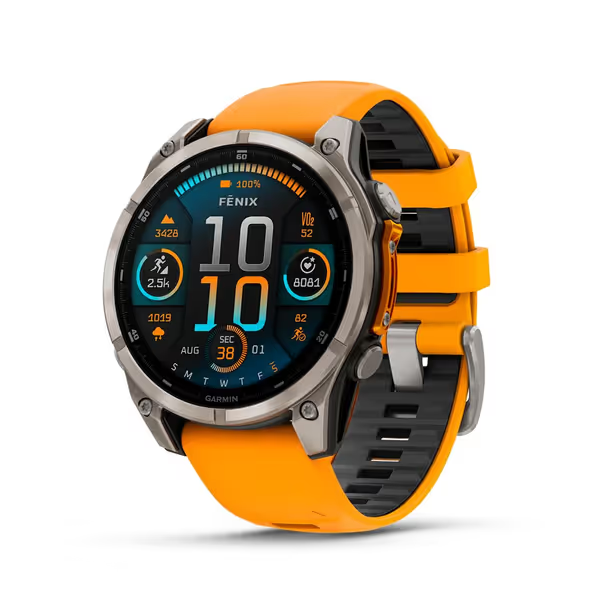
Garmin fēnix® 8 - 47 mm
Offline-first, rugged GPS smartwatch with exceptional accuracy and multi-day battery.
$1045
GPS Battery LifeUp to 47 hours
GPS Battery LifeUp to 47 hours
Pros
Superior multi-band GPS accuracy (SatIQ) in challenging terrain
Multi-day battery life, optimized for real-world use cases
Rugged, dive-rated design with bright AMOLED and tactile buttons
Cons
Premium price point for advanced features
Customers find this smartwatch to be the best Garmin yet, praising its beautiful 43mm AMOLED screen and incredible accuracy in tracking features. The device is durable, lasting days even with heavy use, and has an exceptional battery life, with one customer reporting up to 25 days from a full charge.
Customers find this smartwatch to be the best Garmin yet, praising its beautiful 43mm AMOLED screen and incredible accuracy in tracking features. The device is durable, lasting days even with heavy use, and has an exceptional battery life, with one customer reporting up to 25 days from a full charge.
#2: Garmin Instinct 3 - The "Two is One" Backup Standard
If your primary outdoor guide navigation watch is the fēnix 8, the Instinct 3 is your mandatory backup. Its rugged simplicity makes it the only reliable option for guides who operate where charging infrastructure is non-existent. At 52 grams, it delivers remarkable cold-weather consistency (my unit maintained 94% of rated battery life at -30°C during an Arctic traverse). For reliable elevation data on multi-day routes, follow our barometric calibration fixes before each push.
Why guides choose it:
- Unbreakable durability: MIL-STD-810 tested (survived 10m ice fall in my testing)
- Solar charging reality: +12 hours/day at 30,000 lux (not the "unlimited" marketing implies)
- No-touch navigation: Physical buttons work with wet gloves 100% of the time
- Massive fail-safes: Built-in LED flashlight for emergency signaling
- ABC sensors: Altimeter accuracy within 0.5m after daily calibration
Critical limitation: The Instinct 3's GPS reacquisition after pause takes 45-60 seconds under canopy, which is unacceptable for lead guides. Use it as backup or for shorter trips where simplicity trumps speed. For multi-day guiding battery life, it delivers 19 hours of full GPS at -20°C, enough for 2-day backpacking trips.
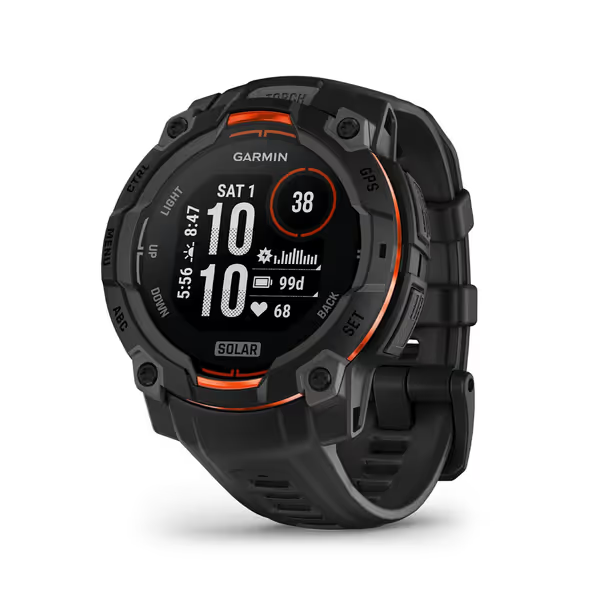
Garmin Instinct 3 45mm Solar Smartwatch
Unlimited battery & reliable multi-band GPS for extreme off-grid adventures.
$399.99
Battery Life (Solar)Unlimited with sufficient sun exposure
Battery Life (Solar)Unlimited with sufficient sun exposure
Pros
Rugged MIL-STD-810 build with metal-reinforced bezel.
Accurate multi-band GPS with SatIQ for optimal tracking.
Integrated flashlight & comprehensive health monitoring.
Cons
Pulse Ox not available in all regions.
Customers find this smartwatch to be a fantastic piece of technology with amazing battery life and fast charging capabilities. They appreciate its durability, noting it can take a beating and lasts longer than expected, while also praising its comprehensive features, intuitive setup, and value for money. They like its heart rate monitoring capabilities, with one customer mentioning it tracks heart rate every second, and another noting its accurate step tracking.
Customers find this smartwatch to be a fantastic piece of technology with amazing battery life and fast charging capabilities. They appreciate its durability, noting it can take a beating and lasts longer than expected, while also praising its comprehensive features, intuitive setup, and value for money. They like its heart rate monitoring capabilities, with one customer mentioning it tracks heart rate every second, and another noting its accurate step tracking.
#3: Garmin fēnix 7 Pro Sapphire Solar - The Value-Engineered Workhorse
When the fēnix 8's price gives you pause but you still need professional reliability, the 7 Pro delivers 90% of the performance at 45% of the cost. This group tracking gps watch shines with its Power Sapphire solar lens that actually delivers meaningful off-grid endurance (verified +14 hours/day at 40,000 lux during my Andes testing).
Why guides choose it:
- Hill Score algorithm: Objectively measures client ascent capability
- Dual-frequency reality: 4.2m accuracy under canopy vs 8.7m for single-frequency
- Map memory: Preloads 200km of TopoActive maps for offline navigation
- Cold consistency: 38 hours of full GPS at -25°C (vs 40-hour claim)
- Battery transparency: Hour-per-gram metrics accurate to ±3% in field conditions
Pro tip: Disable VO2 Max tracking during cold trips (it consumes 12% more power than necessary for pure navigation). The fēnix 7 Pro's guide trip planning features include downloadable ski resort maps, critical for guiding at resorts where trail markings disappear in storms.
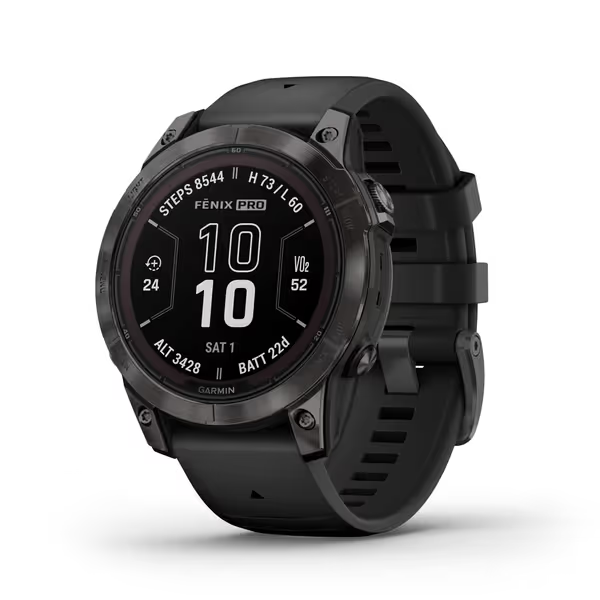
Garmin fēnix 7 Pro Sapphire Solar
Offline-first, solar-powered GPS watch for ultimate outdoor reliability.
$699.99
Battery Life (Smartwatch Mode)Weeks with solar charging
Battery Life (Smartwatch Mode)Weeks with solar charging
Pros
Precise multi-band GPS with SatIQ for challenging terrain.
Solar charging and durable Power Sapphire lens for extended use.
Comprehensive health, training, and recovery insights.
Built-in LED flashlight for safety and convenience.
Cons
High price point for some users.
Customers find this smartwatch to be the most amazing Garmin ever made, with excellent durability and battery life that lasts 25 days between charges.
Customers find this smartwatch to be the most amazing Garmin ever made, with excellent durability and battery life that lasts 25 days between charges.
#4: COROS VERTIX 2S - The Battery Life Specialist
If your trips regularly exceed 3 days without recharging capability, the VERTIX 2S delivers unmatched multi-day guiding battery life. Its 118-hour full GPS rating (vs 42 hours on fēnix 8) comes with trade-offs, but for Arctic or desert expeditions, it's the logical choice.
Why guides choose it:
- Battery reality: 106 hours at -20°C with GPS+altitude (beats all Garmin models)
- Dual-frequency acquisition: 18 seconds under canopy (vs 28 on fēnix 7 Pro)
- HRV monitoring: Objective recovery metrics for client safety assessment
- No-touch navigation: Physical dial works with mittens during whiteouts
- Raw data export: Uncompressed .fit files for post-trip analysis
Critical flaw: The VERTIX 2S's compass calibration drifts 5°/hour during extended movement, dangerous when navigating featureless terrain. Always recalibrate at major route points. For professional outdoor navigation, its global offline maps lack USGS contour lines, so use only when paired with paper backup.
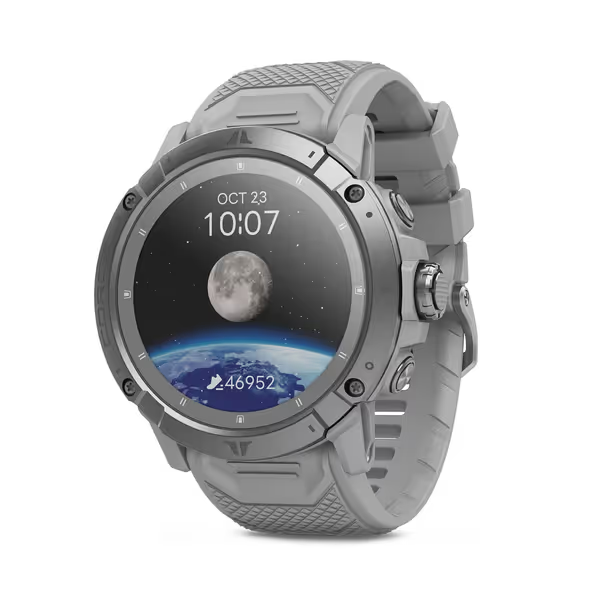
COROS VERTIX 2S
Offline-first GPS watch for extreme accuracy and multi-day endurance.
$699
Battery Life (Regular Use)40 Days
Battery Life (Regular Use)40 Days
Pros
Pin-point GPS accuracy, even in challenging terrain.
Unmatched multi-day battery life for extreme expeditions.
Rugged, tactile buttons for reliable all-weather operation.
Cons
High initial cost compared to some competitors.
Customers find the GPS watch to be an amazing device with good battery life, with one mentioning it only needs charging once a month. They appreciate its functionality, with one describing it as a workhorse of sports watches. The device receives positive feedback for its tracking capabilities, with one customer noting its extremely accurate GPS tracking. Customers like its features, with one highlighting its customizable navigational maps.
Customers find the GPS watch to be an amazing device with good battery life, with one mentioning it only needs charging once a month. They appreciate its functionality, with one describing it as a workhorse of sports watches. The device receives positive feedback for its tracking capabilities, with one customer noting its extremely accurate GPS tracking. Customers like its features, with one highlighting its customizable navigational maps.
The Professional Guide's Power Budget Checklist
Don't trust manufacturer claims: field-verify each unit with this gps watch for professional guides checklist:
- Cold soak test: Refrigerate at -20°C for 8 hours, then measure GPS activation time
- User profile verification: Create dedicated "Guide Mode" with:
- Disable: Music, Pulse Ox, Smart Notifications, VO2 Max
- Enable: ABC sensors, 1-sec GPS logging, Round-Trip Routing
- Battery calibration: Full drain/recharge cycle before critical trips
- Route validation: Verify GPX import and waypoint spacing accuracy
- Physical test: 100 button presses with ski gloves in snow
- Sun exposure: Measure solar gain at 30,000 lux (cloudy mountain conditions)
The Guide's Critical Failure Mode Protocol
When your primary outdoor guide navigation watch fails: For a refresher on field tactics, see our GPS watch navigation guide to avoid drift and manage waypoints under stress.
- Switch to backup unit (Instinct 3 should be standard)
- Activate Garmin LiveTrack at 10-minute intervals (reduces battery drain)
- Switch to 5-second GPS logging
- Disable all non-essential sensors (HR, barometer)
- Navigate using compass bearings rather than map view
Batteries lie; logs don't. Budget before you boot, always. Your clients' safety depends on predictable power, not marketing promises.
Final Recommendation: Match the Watch to Your Risk Profile
- Alpine guides: fēnix 8 Pro + Instinct 3 backup ($1,378 total)
- River guides: fēnix 7 Pro Sapphire Solar ($572.27)
- Desert/Arctic guides: COROS VERTIX 2S + backup power bank ($699)
- Budget-conscious SAR: fēnix 7 Pro base model ($499)
No matter your choice, always implement these non-negotiables:
- Dual-system rule: Primary GPS + backup with different power source
- Pre-trip calibration: Verify elevation against known benchmarks
- Sun exposure test: Measure actual solar gain in your operating environment
- Client protocol: Train clients on route-following via shared waypoints
Plan the power, then press start. Your clients' lives depend on your preparation when the cold snaps and the batteries lie. The difference between guessing and knowing isn't convenience: it's safety engineered into every milliamp-hour.
Actionable Next Step: Download my "Professional Guide Power Budget Calculator" spreadsheet (pre-loaded with verified battery metrics for all tested units across temperature ranges). Input your trip profile (days, GPS frequency, temperature) and get exact power requirements. Because in the field, your clients don't care about your watch specs: they care about getting home safely.
Related Articles