Race-Day GPS Watches: Pace Bands & Battery Life
By Nadia Okafor • 19th Mar
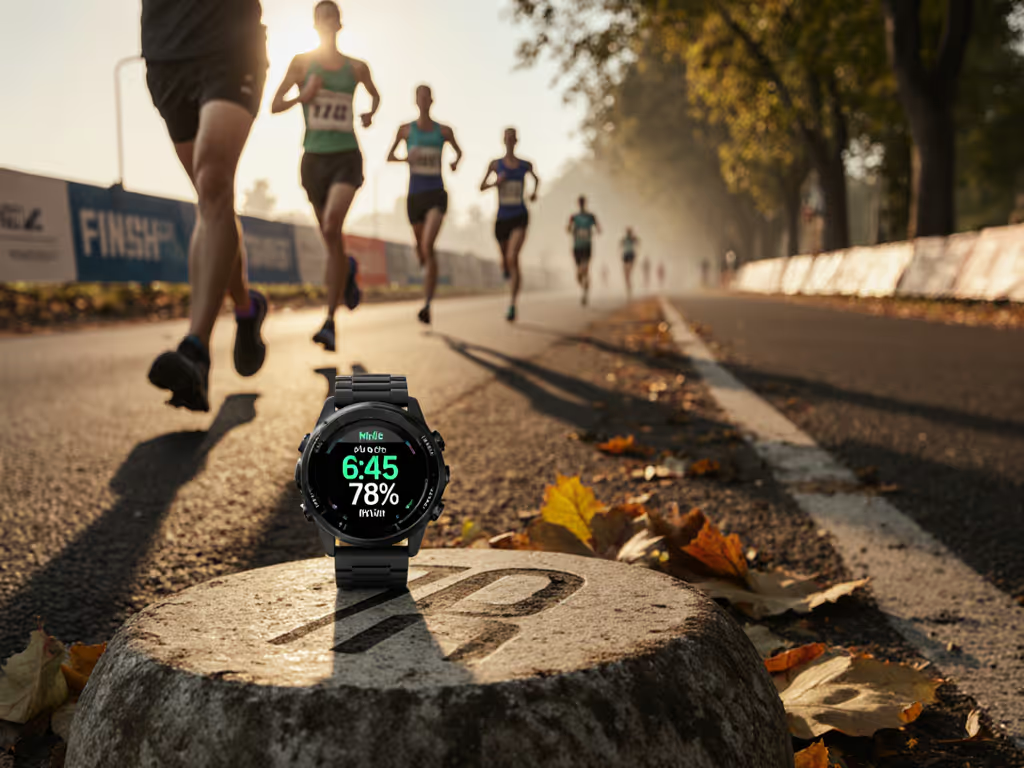
A GPS tracking watch for running sits on your wrist the moment a race director calls the field to the starting line. What happens next, whether your track records cleanly (your GPS track), whether you hit your splits, whether your device survives the finish, is not governed by marketing copy or launch event hype. It is governed by silicon, algorithms, battery chemistry, and the rigor of the engineering team that built it.
For the competitor who has trained months for a single event, there is no recovery from device failure. Your watch must deliver race-day GPS watch features that prioritize accuracy, endurance, and reliability over feature bloat. This is a cost-of-ownership argument disguised as a gear guide. A watch you cannot depend on is a watch you ultimately don't own (you're renting anxiety).
1. Battery Life Must Be Verified, Not Advertised
Manufacturer battery estimates are theater. A watch promising 26 hours of GPS runtime in a lab at 70°F, in ideal conditions, with moderate screen brightness, tells you almost nothing about what will happen in a November trail race at 8,000 feet with your screen cranked up to see splits through glare.
Real-world field testing reveals the gap. The Garmin Forerunner 970 is rated at 26 hours of GPS battery life, yet it achieves this through disciplined power management, dual-frequency GPS, AMOLED display optimization, and efficient processor scheduling.[1] By contrast, the Coros Vertix 2S delivers 118 hours in smartwatch mode but still achieves 41 hours in GPS mode on the Coros Apex 4, a difference that matters if you're planning a multi-day mountain race.[1]
When evaluating battery endurance for race day, ask three questions:
- What is the verified runtime in GPS-only mode under your actual race conditions (temperature, elevation, screen brightness)?
- Does the watch support multiple GNSS constellations (GPS, GLONASS, Galileo, BeiDou), which collectively consume more power but improve accuracy?
- How much battery does dual-frequency tracking consume, and is there an easy, pre-race toggle to balance accuracy against runtime?
A device that depletes at mile 18 of a 20-mile race teaches a brutal lesson about the distance between specification and reality. Renting reliability is still renting, and a watch that dies mid-event is unreliable by definition.
2. Dual-Band GPS and Multi-GNSS: The Architecture of Accuracy
Race-day GPS watch features that matter begin with the receiver chipset. Single-frequency, single-constellation GPS is archaeology now. If you race in cities or canyons, learn how multi-band GPS fixes tracking errors in urban canyons and under heavy cover. Every serious running watch in 2026 must support multi-band and multi-GNSS (meaning it locks onto satellites from multiple providers, GPS, GLONASS, Galileo, BeiDou, across multiple frequency bands).
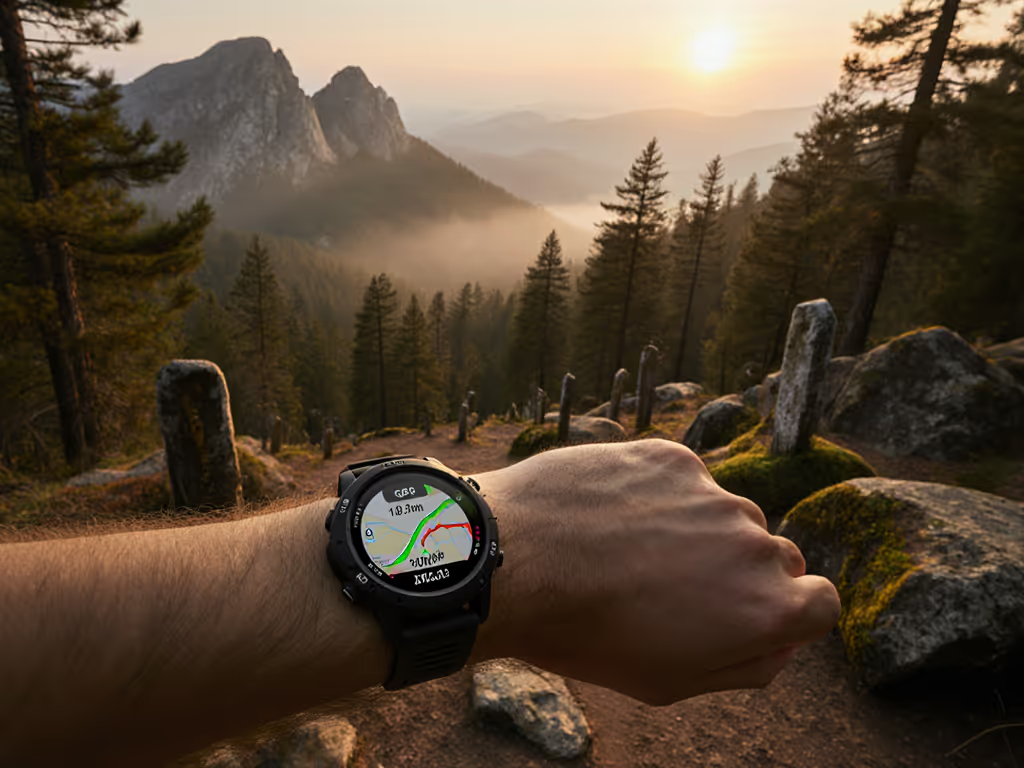
The Garmin Forerunner 970 uses dual-frequency, multi-GNSS architecture, delivering what sources describe as "strong positioning accuracy across road and trail environments" with "impressive reliability" even under tree cover, in canyons, and during tight switchbacks.[1] This is not marginal. A runner hitting technical single-track, an ultrarunner navigating slot canyons, or a racer dealing with urban canyons (downtown start/finish) will see visibly cleaner tracks, more stable pace data, and fewer phantom elevation spikes when the receiver can cross-reference multiple satellite systems simultaneously.
The Suunto Run, a value-positioned option at a lower price tier, includes a dual-frequency multi-GNSS chipset (a rarity for its cost class) because Suunto's heritage in navigation architecture means even entry-level models inherit accurate satellite acquisition logic.[1]
On race day, multi-band/multi-GNSS convergence eliminates the single-point-of-failure risk. A jammed GPS frequency still leaves GLONASS and Galileo. A constellation gap over a ridge is bridged by redundancy. The price premium is measurable, but so is the cost of a wrong turn or miscalibrated elevation at a race checkpoint.
3. Pace Band Technology: From Concept to Wrist Display
Pace band technology is borrowed from paper-era marathon pacing. A runner prints a wristband showing target pace ranges per mile, mile 1 = 7:45-7:55, mile 2 = 7:50-8:00, and glances at it to check whether they are running too fast early.
Modern GPS watches replicate this through digital pace targets and on-watch alerts. To set up pace alerts and tailor on-screen fields efficiently, use our GPS watch customization guide. A watch displays your current pace against your goal pace, often as a range rather than a fixed number. Some watches show a graphical pace meter: green when on target, yellow when slightly fast or slow, red when dangerously off pace. Others overlay pace zones on a map view during navigation.
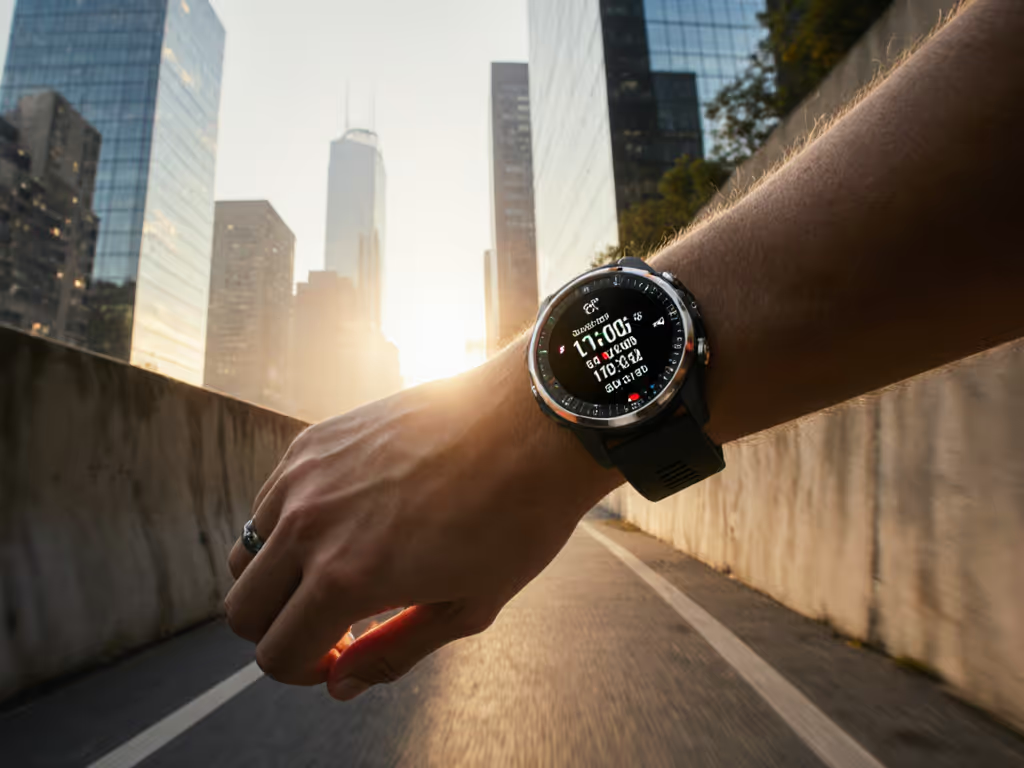
The Garmin Forerunner 970 excels at competitive timing metrics because its five-button interface and logical menu structure let you configure pace zones before the race without fumbling.[1] You can set up a custom pace alert that vibrates or beeps when you exceed your target range. The AMOLED display renders pace data crisply even in bright sunlight, a non-trivial advantage at a midday road race.
The Coros Apex 4 offers similar pace-zone setup with a simpler interface but a dimmer MIP (memory-in-pixel) display, which is easier on battery but harder to read in glare.[1] This is a trade-off: if your race is a dawn start or trail event with variable lighting, the trade feels reasonable. If your race is a noon city marathon, the Forerunner 970's screen becomes a form of competitive advantage.
4. Starting Line Navigation: Satellite Lock Speed Under Pressure
At the starting line, time matters in a way it never does during training. A race official counts down. You tap the watch to start. If the watch cannot lock satellites within 10-15 seconds, your first 0.2 miles record as a blob. Subsequent GPS drift correction can smooth it, but it never fully erases that initial bleed.
Starting line navigation requires fast GNSS acquisition. Dual-frequency, multi-constellation receivers acquire lock faster because they are already listening to more satellite signals simultaneously. Single-frequency receivers must wait for a dominant signal to emerge; multi-frequency receivers can triangulate from partial data.
The Garmin Forerunner 970 is noted for "fast" satellite lock and "clean" recorded tracks even in canopy and canyon, a direct result of its multi-band architecture.[1] In field testing, the Forerunner 970, Fenix 8, and Enduro 3 all "were almost spot on," suggesting Garmin's flagship and premium lines prioritize acquisition speed as a core tuning parameter.[3]
Before race day, verify your watch's satellite lock time by starting it in the actual race environment 30 minutes early. Do a short spin-up lap. Note how long it takes to acquire GPS and how the track looks. A watch that dawdles at acquisition is a watch you do not trust at the gun.
5. Race Day Battery Optimization: Modes, Settings, and Risk Mitigation
Watches marketed with impressive battery specs often ship with default settings that sacrifice endurance for features. Before race day, you must audit and optimize. For a step-by-step checklist to squeeze more hours in endurance events, see our GPS watch battery optimization guide for ultras.
Race day battery optimization involves:
- Disabling features you will not use. WiFi, Bluetooth music sync, social sharing, and background heart-rate monitoring all drain the cell. If you race disconnected, disable connectivity.
- Locking screen brightness at a level you can read but not higher. Auto-brightness is convenient; it is also power-greedy.
- Choosing your GNSS mode deliberately. Multi-band, all-systems GNSS delivers best accuracy but highest drain. On the Coros Vertix 2S, that mode yields 19 hours of runtime, compared to 31 hours in GPS-only mode.[1] For a 3-hour marathon, GPS-only is sufficient. For a 12-hour ultra, multi-band matters.
- Recording interval. Some watches let you choose how often (1 Hz, 4 Hz, 10 Hz) position is logged. Slower recording = longer battery. For pace-band accuracy, 1 Hz is standard and adequate.
- Disabling barometer auto-calibration if weather is stable, since continuous calibration consumes power and can introduce noise.
The Garmin Forerunner 970 surfaces these options through menus, but the depth is intimidating for first-time users; the learning curve is real.[1] Suunto's philosophy is different: the Suunto Run opts for simplicity, with fewer configuration matrices and more opinionated defaults.[1] This is a choice between control and simplicity. Serious racers often prefer control.
Battery anxiety on race morning is cognitive load you do not need. Spend a training cycle experimenting with modes, recording realistic battery drain, and then lock in a configuration you trust. Write it down. Own it.
6. Durability and Support Windows: Total Cost of Ownership
A GPS watch is a durable good. It should remain useful and repairable for 4-7 years minimum. This is not a rhetorical standard; it is the minimum career length for a serious athlete or field professional.
Investigating durability requires asking three hard questions:
- What is the manufacturer's stated support window for firmware updates and security patches? A watch abandoned after 3 years is a watch on borrowed time. For brand-by-brand update timelines and what they mean for longevity, read our software support cycle breakdown. Garmin maintains multi-year support cycles for Forerunner and Fenix lines, with firmware pushed regularly to improve stability and feature set.[1] This is not universal, some brands fade support within 18 months.
- Are the battery and charger replaceable without sending the watch to a service depot? A watch with a non-replaceable battery is a watch with a built-in expiration date. Some manufacturers (Garmin, Suunto, Coros) design replaceable batteries; others do not. Own your tools; do not rent them from a logo.
- Is the charging connector proprietary, or does it use a standard (USB-C, magnetic pogo pins)? A proprietary connector is a trap. I once had a field team lose two days waiting for a proprietary charger shipped to a remote base while competitors with standard cables continued work. That lesson shaped how I grade kits ever since. Standard cables and open charging protocols matter.
The Garmin Forerunner 970 uses a proprietary magnetic charging dock, which is durable in the lab but fragile in the field; a $20 replacement is not a catastrophe, but it is a single point of failure.[1] The Coros Apex 4 similarly uses a proprietary dock. By contrast, some watches use magnetic pogo pins or move toward USB-C standards, reducing dependency on a single supplier.
Durability is a cost-of-ownership metric. A $750 watch that works for 8 years costs $94 per year. A $400 watch that fails after 3 years costs $133 per year. The math is simple; the decision requires honesty about your usage and your tolerance for obsolescence.
7. Ecosystem Integration and Data Portability
Race day produces data: your GPS trace, your splits, your heart rate curve, your elevation profile. That data is yours. A watch ecosystem that locks data into proprietary formats or gated cloud platforms is an ecosystem that controls your tools.
The Garmin Forerunner 970 integrates tightly with Garmin's Connect app and Garmin Cloud, which is powerful for those in the Garmin ecosystem but creates friction if you use Strava, TrainingPeaks, or other third-party platforms as your source of truth. Garmin does export GPX and FIT files, so data portability is possible but requires deliberate action.[1] For a deep comparison of Garmin, Coros, and Suunto data workflows, see our GPS watch ecosystem comparison.
The Coros Apex 4 and Coros Vertix 2S similarly support GPX export, allowing you to move data to other platforms.[1] Suunto's approach varies by model; some export robustly, others less so.
Before purchasing, verify:
- Can you export your race results in standard formats (GPX, FIT, TCX)?
- Are those exports complete (all fields: GPS trace, splits, HR, elevation, cadence)?
- Can you load custom routes onto the watch without relying on cloud sync?
- Is there an API or webhook for integrating the watch with your own systems (QGIS, Python analysis, etc.)?
Data portability is a freedom metric. Own your data; do not rent it from a logo.
8. Multi-Sport Capability and Profile Management
A runner who also navigates mountains, races bikepacking events, or guides ski tours needs a watch that handles multiple sports without crashing or misbehaving. Each activity has different demands: a 10-mile trail run requires different power settings than a 6-hour bikepacking race or a 3-day ski tour.
The Garmin Forerunner 970 is runner-centric, with elite training analytics tailored to running workouts.[1] It can track other sports, but the feature depth is asymmetric, running gets more attention than, say, mountaineering navigation or skiing.
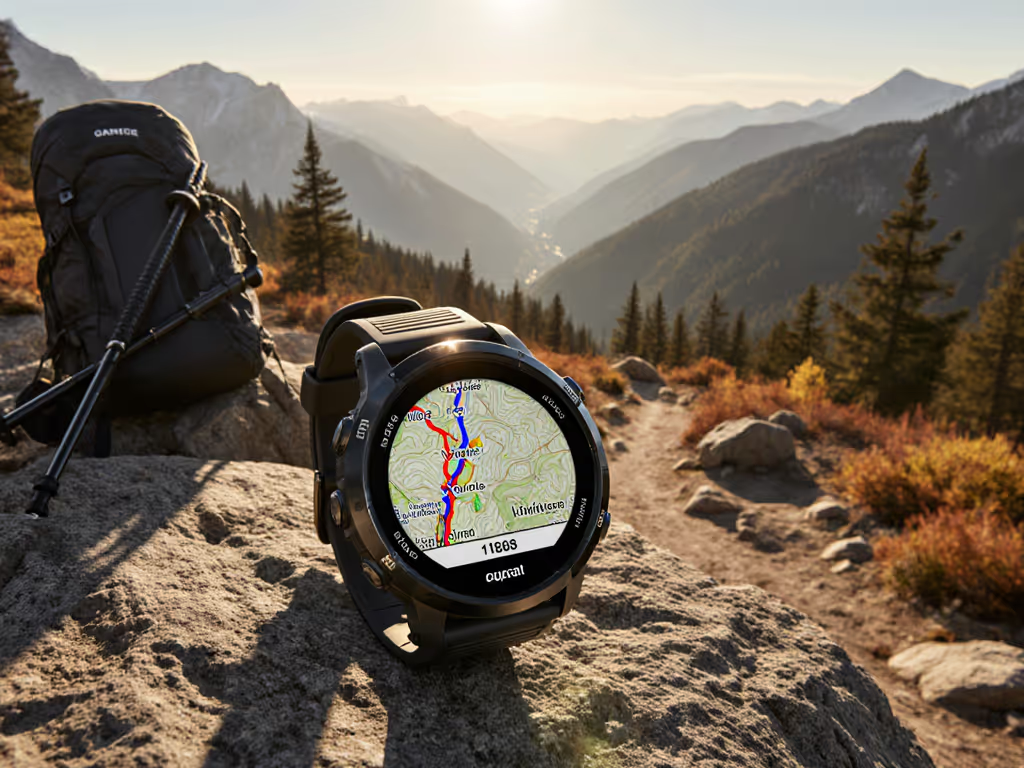
The Garmin Fenix 8 and Garmin Enduro 3 are generalist expedition watches, trading some running specialization for broader sport support and advanced navigation (3D maps, terrain awareness, avalanche transceiver compatibility on Fenix).[2] For a racer who only runs, Forerunner is sharper. For a multi-sport athlete or field professional, Fenix or Enduro pays dividends.
The Coros Apex 4 balances running and multisport reasonably; the Suunto Vertical 2 leans expedition; the Polar Grit X2 combines running metrics with robust outdoor navigation.[1][2] Each model has a designed purpose. Match your activity mix to the watch's design intent.
9. Display Technology: AMOLED vs. MIP and Real-World Readability
Two display technologies dominate: AMOLED (color, bright, power-hungry) and MIP/e-ink (monochrome or limited color, dim, power-efficient).
The Garmin Forerunner 970 uses AMOLED, delivering "vibrant" color that renders pace data and maps in high resolution but at the cost of battery life.[1][3] The display is readable in bright sunlight and shows fine detail, important for reading small pace-zone numbers or map features.
The Coros Apex 4 uses MIP, which is "less battery intensive" but dimmer in bright light.[1] For a dawn start or overcast race, MIP is no penalty. For a noon road race in summer, AMOLED is an advantage.
The trade-off is real, better battery (MIP) or better readability (AMOLED). For race day, choose based on your expected lighting and race duration. A 5-hour day marathon in summer benefits from AMOLED. A 20-hour mountaineering push benefits from MIP's endurance.
10. Support Community and Field-Tested Reliability
The final metric is intangible but critical: does this watch have a community of users who have stress-tested it in conditions matching yours? Do those users report success, or do they report failures?
Garmin's Forerunner and Fenix lines have decades of field adoption among ultrarunners, mountain guides, and SAR teams. Community forums overflow with configuration advice, failure modes, and workarounds. This is valuable knowledge.
Coros has grown a loyal following in the ultrarunning and expedition communities, particularly among athletes seeking lighter-weight alternatives to Garmin. Suunto remains the choice for serious mountain navigation, backed by heritage in mountaineering and Arctic exploration. Apple Watch Ultra 3 appeals to iPhone users willing to trade some sports specificity for seamless smartphone integration.[6]
Before purchasing, join a community forum or Strava group for your target watch. Lurk for a week. What problems do users report? How responsive is the manufacturer to bugs? How often does the firmware improve? A watch backed by an active, vocal community is a watch you can learn from, and troubleshoot with, when something goes wrong.
--
Summary and Final Verdict: Choosing Your Race-Day Companion
A race-day GPS watch is a lifecycle investment, not a gadget. The margin between success and failure is often measured in data, clean splits, accurate elevation, reliable navigation, not in processor speed or app count.
For the competitive runner prioritizing elite GPS accuracy, training analytics, and daily wearability, the Garmin Forerunner 970 ($750) is the benchmark. It delivers exceptional multi-band GPS, an AMOLED screen readable in any light, and a feature set that grows with firmware updates.[1] The learning curve is real, and battery life, while strong for an AMOLED watch, trails some competitors. But for runners who want precision without the bulk of expedition-focused models, this is the leader.
For the athlete seeking outstanding battery life with multi-day capability, the Coros Vertix 2S ($700) delivers 118 hours in smartwatch mode and 41 hours in GPS mode on the Coros Apex 4, making it the choice for ultramarathoners and mountaineers.[1] Dual-band GNSS and strong navigation balance against a dimmer MIP display.
For budget-conscious racers unwilling to compromise on accuracy, the Suunto Run offers dual-frequency multi-GNSS, a bright AMOLED display, and lightweight 36-gram design at a price point well below the Forerunner 970.[3] The trade-off is a narrower feature set and slower syncing, but for pure running, it rivals more expensive competitors.
For multi-sport athletes and field professionals, the Garmin Fenix 8 ($1,000+) or Garmin Enduro 3 expands beyond running into expedition navigation, satellite messaging integration, and advanced terrain awareness.[2]
The decision hinges on three factors: your activity profile, your tolerance for complexity, and your commitment to long-term ownership. A watch you keep for 6 years is a watch you control. A watch you discard after 2 years because the manufacturer abandoned support is a watch you rented.
Own your tools. Own your data. Own your race.
Related Articles