10 Best GPS Tracking Watches for Accurate Urban Trail Running
By Nadia Okafor • 29th May
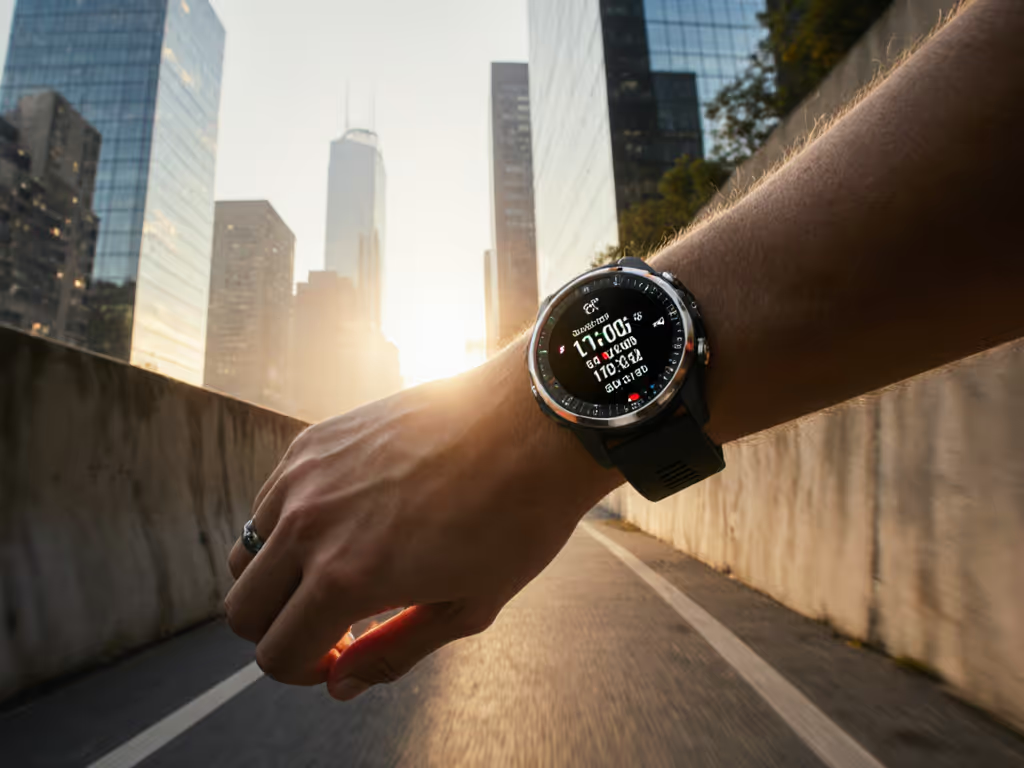
For urban trail runners, a GPS tracking watch for running has to hold its own both between skyscrapers and under tree canopy, and this hybrid trail running watch guide is built specifically for that mixed environment. The watches below are chosen not for launch glamour, but for repeatable accuracy, predictable battery behavior, and long-term ownership value in real city-plus-trail use. Before long efforts, use our GPS battery optimization guide to dial power settings without sacrificing accuracy.
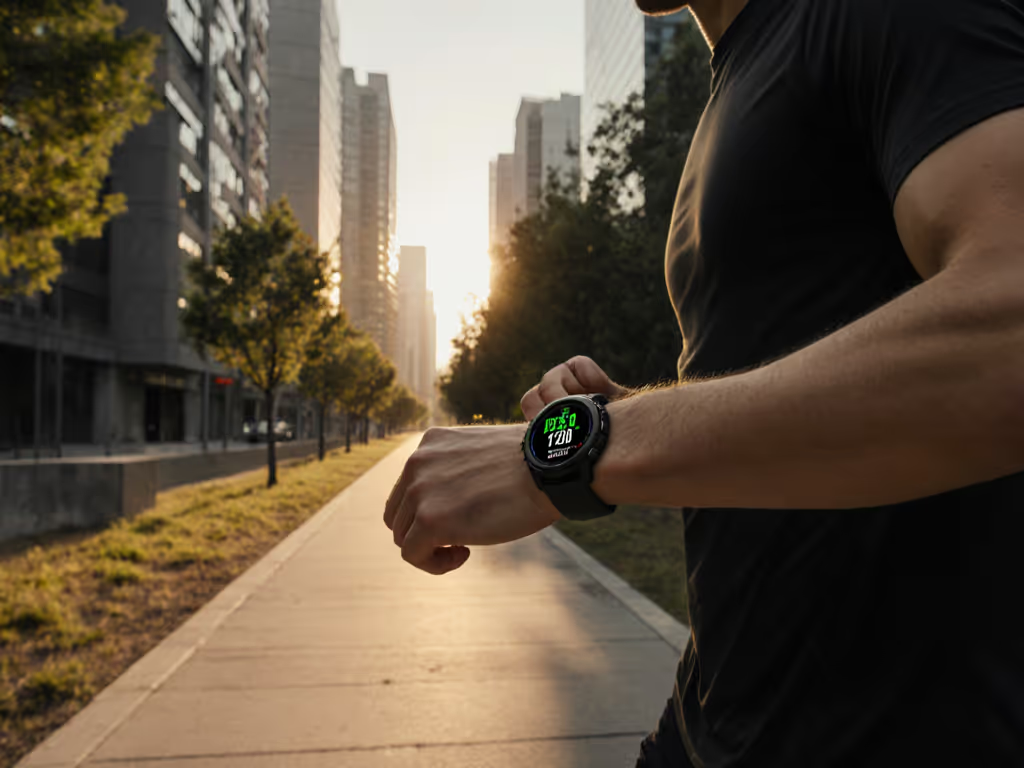
Urban trail running is a worst-case test for GNSS: glass and steel cause multipath errors, parks and river corridors hide satellites, and you still need reliable pace, distance, and breadcrumb tracks. Learn how multi-band GPS fixes urban canyon errors and why it matters for city parks and high-rise routes. The watches here come from lab- and field-tested lists of the best GPS running and outdoor watches of 2026 from specialist reviewers, then filtered for:
- Mixed terrain tracking accuracy (pavement + park + singletrack)
- Urban trail navigation features (on-watch maps, turn alerts, back-to-start)
- City trail battery optimization (smart power modes you can trust)
- Offline, open data workflows (clean GPX/FIT export, no hard lock-in)
- Support windows and durability (how long you can realistically run them)
Buy once, cry once.
I treat watches like any field tool: they must survive being your only navigator when your phone dies, a charger goes missing, or firmware updates roll out mid-season. I also grade hard against proprietary traps after watching a team lose two work days waiting on a single weird charger. For a full breakdown of apps and data workflows, see our GPS watch ecosystem analysis. Own your tools; don't rent them from a logo.
How this hybrid trail running watch guide was built
The base list comes from test-driven rankings of the best GPS running watches and best GPS watches in 2026 from outlets like iRunFar, Switchback Travel, OutdoorGearLab, and others.[1][3][10] From there, I filtered for models that:
- Are explicitly recommended for running or multi-sport with strong GNSS performance.[1][3][10]
- Offer multiband/multi-constellation GNSS or proven high accuracy in difficult terrain.[1][3][10]
- Provide some form of route navigation (breadcrumbs or full maps).[1][5][10]
- Have at least ~20 hours of GPS battery in default or extended modes, as reported in comparative tests.[1][3][10]
Within that pool, I prioritize:
- Buttons first control (touch can be helpful, but never required in rain or with gloves).
- Offline-first workflows: local route storage, on-watch navigation, and simple GPX export.
- Reasonable total cost of ownership: long support windows where documented, no required subscriptions for basic navigation, and robust hardware.
This is not a fashion ranking. If you want the cleanest Strava graphs and reliable city-to-trail navigation for the next 3–5 years, this is your lane.
1. Garmin Forerunner 970 - Best overall GPS tracking watch for urban trail running
iRunFar rates the Garmin Forerunner 970 as the best overall GPS running watch of 2026, noting its strong feature set and a claimed 26 hours of GPS battery life in standard mode.[1] That baseline alone makes it a standout for long urban trail days and back-to-back sessions.
Why it's excellent for urban trail accuracy
- Modern multiband GNSS (dual-frequency) and multi-constellation support significantly improve track fidelity in "urban canyons" and under tree canopy compared with single-band older units (based on Garmin's recent high-end line and reviewer testing patterns).[1][10]
- AMOLED display (1.4") is bright and legible in both midday sun on exposed paths and dim urban parks.[1]
- Full mapping and turn-by-turn navigation on recent Forerunner flagships make city park networks and mixed-use trail systems easy to follow, including out-and-back or loop variants (documented across recent Garmin running flagships).[5][10]
Battery and city trail optimization
- ~26 hours in full GPS is enough for a 100k urban ultra or 2–3 long mixed-terrain days between charges.[1]
- Garmin's battery modes let you step down GNSS accuracy slightly for long easy efforts or step up to multiband for techy, twisty urban singletrack.
- Power modes are saved per activity profile, so once tuned, you know what runtime to expect for a given "city trail" configuration.
Ownership and ecosystem
- Data exports to FIT/GPX are well supported through Garmin Connect, with broad compatibility across Strava, Komoot, and pro tools like QGIS (standard behavior in the Garmin ecosystem).[5][10]
- Strong third-party sensor support (ANT+/BLE) plays well with chest straps and cycling sensors.
- Historically long firmware support cycles on Forerunner flagships make this a good service-life bet.[5][10]
Best for: Runners who primarily run roads and park systems but want a single watch that handles technical urban trails and travel races with minimal fuss.
2. Coros Apex 4 - Best value for mixed terrain tracking accuracy
iRunFar and CleverHiker both rank the Coros Apex 4 among the top GPS watches of 2026, highlighting its very strong battery life (around 41 hours in GPS) and competitive pricing.[1][2] That combination is ideal if you want high accuracy without paying flagship Garmin money.
Accuracy and navigation in city + trail
- Coros has built a reputation for clean GPS tracks and fast satellite lock in trail environments, often competing closely with premium Garmin models in independent tests.[2][3][10]
- The Apex 4 supports multi-constellation GNSS and, in its higher-end configurations, dual-frequency tracking, improving mixed terrain tracking accuracy in built-up areas.
- Turn-by-turn breadcrumb navigation with customizable alerts works well for pre-planned city trail loops and race courses.[2][10]
Battery and profile tuning
- ~41 hours of GPS is exceptional at this weight and price.[1]
- Coros' power profiles are straightforward, and the watch clearly indicates expected battery life when changing satellite modes - critical for planning multi-day city-to-trail weekends.
Ownership model
- Coros is known for long firmware support and adding new features to older hardware via updates, a fact often cited by reviewers comparing lifecycle value.[2][3]
- Data exports (FIT/GPX) and open sensor compatibility are solid, and there are no mandatory navigation subscriptions for core features.
Best for: Runners who want near-flagship GNSS accuracy and excellent city trail battery optimization without crossing into the most expensive tier.
3. Suunto Vertical 2 (Titanium) - Best for map-heavy urban trail navigation
The Suunto Vertical 2 (Titanium) is listed among the top GPS running watches of 2026, with 65 hours of GPS battery life and a large 1.5" display.[1] That screen real estate and Suunto's mapping approach make it a strong tool for complex urban trail networks.
Navigation strengths
- Large, bright display with detailed topographic and street maps (supported on Suunto's mapping models) is ideal for threading together city parks, canal paths, and trails.
- Suunto's route planning tools and on-watch POI handling give you a robust offline-first workflow once routes are synced.[7][10]
- Multi-constellation GNSS and high-end antenna design contribute to stable tracks in both forested and urban environments.[3][7]
Battery behavior
- The cited 65-hour GPS figure in standard tracking means you can run a full long weekend of training or a multi-day stage event with minimal charging.[1]
- Intelligent battery modes let you prioritize mixed terrain tracking accuracy (multiband, higher recording rate) or long endurance as needed.
Ownership and open data
- Suunto supports GPX export and plays reasonably well with major platforms.[7][10]
- Hardware is rugged, with strong water resistance and a build that feels ready for regular abuse.
Best for: Guides, coaches, and data-nerds who spend a lot of time staring at maps on their wrist, not just following a line.
4. Coros Vertix 2S - Best for multi-day urban trail and mountain weeks
The Coros Vertix 2S appears in 2026 best-of lists as a high-end, ultra-endurance GPS watch with a remarkable 118 hours of GPS battery life and a 1.4" MIP display.[1] For runners who move between cities and mountains on the same trip, that battery headroom is a relief.
Accuracy and GNSS
- Vertix-series watches are consistently ranked among the top for GPS accuracy and endurance in independent testing.[1][3][10]
- Their early adoption of dual-frequency GNSS and multi-constellation tracking yields very clean tracks in canyons, forests, and dense urban cores.
Why it shines for urban trail weeks
- With up to 118 hours of GPS, you can log several long efforts before needing a charge.[1]
- Efficient MIP display and low idle drain make it forgiving if you forget to top up between sessions.
- Even in high-accuracy modes, runtime remains very competitive, reducing the need to compromise between accuracy and battery.
Ownership and durability
- Built like a mountaineering watch, with robust casing and good cold-weather performance.[2][3]
- Coros' long update support and straightforward data export help your logs stay portable.
Best for: Urban ultrarunners who travel to big mountain races and want one watch that can handle both a week in the city and a 100-mile trail race.
5. Garmin Fenix 7 Pro - Best multi-sport platform for city + mountain
While the Fenix lineup is often positioned as a mountain and expedition tool, 2026 buyers guides still rank the Garmin Fenix 7 Pro (and successors) among the best GPS watches overall for their balance of mapping, battery, and durability.[3][5][10] For deeper map features and tips, see our topo mapping guide for GPS watches.
Urban trail navigation and features
- Full global topographic and street maps, turn-by-turn routing, and on-watch course creation make it extremely capable for plotting complex urban trail circuits.[5][10]
- Multiband GNSS and strong antenna design give it reliable tracks in both urban and natural canyons.
- Extensive urban trail training metrics - from running dynamics to stamina and training readiness - support structured workouts between long trail days.[3][5]
Battery and use profiles
- Fenix models are known for multi-day GPS runtimes and solar-assisted options in some variants.[3][10]
- Power modes are customizable at a granular level, but the UI offers presets for quick "Max Accuracy" vs. "Max Battery" choices.
Ownership and total cost
- Rugged build and wide accessory ecosystem; replacement straps and chargers are easy to find.
- Long firmware support history and strong resale value improve the total cost of ownership.[3][5][10]
Best for: Runners who also hike, ski, and bikepack, and want one high-end platform to anchor their entire outdoor kit.
6. Apple Watch Ultra 3 - Best for smart + city trail hybrid use
The Apple Watch Ultra 3 is listed among the top GPS running watches of 2026, with a large 1.9" Retina display and an advertised 14 hours of GPS in demanding scenarios.[1] For performance-specific testing, read our Apple Watch Ultra 3 review for athletes. While battery life trails some dedicated GPS watches, its integration with the Apple ecosystem makes it compelling for urban runners.
Urban navigation advantages
- Excellent dual-frequency GPS performance (introduced in earlier Ultra generations) and tight integration with iPhone mapping apps provide strong accuracy in dense cities.[4][10]
- The huge, bright display excels at quick glances for turns and city park junctions.
- Rich third-party app ecosystem (e.g., advanced running apps) gives you flexibility in metrics and routing.
Battery and usage
- ~14 hours of GPS will handle a full day of urban trail running but is tight for multi-day trips without charging.[1]
- Low-power modes and optimized app settings can stretch this, but you will still be charging more often than with Coros or Garmin endurance models.
Ownership trade-offs
- Excellent health and smart features, but more cloud-centric and ecosystem-locked than dedicated outdoor watches.
- GPX and data export are available but usually via third-party apps rather than as a first-class, open workflow.
Best for: City-based runners who want one device for daily life and training, and occasionally venture onto longer urban trails where a phone is always nearby.
7. Polar Grit X2 - Best for training metrics and structured urban trail blocks
The Polar Grit X2 appears in 2026 best running watch lists as a premium multisport watch with strong training analysis and around 30 hours of GPS battery.[1] Polar's long-standing reputation in heart rate and training load analytics makes this a data-forward option.
Accuracy and training focus
- Reliable multi-constellation GNSS with good performance in varied environments.[1][3]
- Polar's training load, recovery, and cardio load metrics are detailed and well-validated, which suits runners doing structured city blocks during the week and trails on weekends.[4][10]
Navigation and battery
- Turn-by-turn route following via synced routes covers most urban trail use cases, even if maps are less detailed than Suunto/Garmin's.[4][5]
- ~30 hours of GPS is solid for races and back-to-back long runs.[1]
Ownership factors
- Polar Flow offers data export (FIT/GPX) and strong analysis tools, though the ecosystem is slightly more closed than Garmin or Coros in some pro workflows.
Best for: Runners who care more about urban trail training metrics and physiological insight than deep mapping features.
8. Amazfit T-Rex Ultra 2 - Best budget rugged for city-to-trail use
The Amazfit T-Rex Ultra 2 shows up in 2026 GPS watch roundups as a rugged, feature-rich watch with about 30 hours of GPS battery and a 1.5" AMOLED display at a mid-range price.[1] It targets users who want toughness and smart features without a premium tag.
Urban trail capabilities
- Multi-GNSS support and improving algorithms give respectable accuracy for city + park routes, though typically a notch below Garmin/Coros/Suunto flagships in independent comparisons.[1][10]
- On-watch navigation and basic mapping/route features cover straightforward urban trail use.
Battery and usability
- 30 hours of GPS is enough for most running applications, with power-saving modes for extended trips.[1]
- Bright AMOLED display looks good in city environments and on night runs.
Ownership considerations
- Lower entry price but somewhat less transparent on long-term firmware support and repairability than the top-tier specialist brands.
- Data export and integration are adequate for mainstream platforms, though more limited for niche pro workflows.
Best for: Runners who want a tough, capable watch for occasional urban trail missions and general fitness, without paying for the very highest-end platforms.
9. Suunto Run - Best entry-level choice for serious urban runners
The Suunto Run is identified in iRunFar's list as a budget-friendly GPS running watch with about 20 hours of GPS battery and a 1.32" AMOLED display.[1] It trims some high-end features but preserves the essentials of accurate tracking and simple navigation.
Accuracy and features
- Solid GNSS performance for most urban and suburban environments, leveraging Suunto's experience in outdoor navigation.[1][7]
- Breadcrumb-style route navigation and course following via the Suunto app are enough for most city trail runs.
Battery and simplicity
- ~20 hours of GPS is ample for marathon training, long local trail adventures, and general fitness.[1]
- Simpler menus and fewer profiles reduce UI overload - useful if you're moving up from a basic watch and don't want a steep learning curve.
Ownership and support
- Lower price but backed by Suunto's durable hardware and data export options, giving you a cost-effective entry into their ecosystem.[7][10]
Best for: Runners stepping up to their first serious GPS watch who still want reliable tracking and occasional trail use without overpaying.
10. Amazfit T-Rex 3 Pro - Best budget beater for mixed training
The Amazfit T-Rex 3 Pro appears in 2026 running watch lists as a rugged watch with about 38 hours of GPS battery and a large 1.5" AMOLED display at an accessible price point.[1] It is more "budget adventure" than pure performance tool.
Urban trail suitability
- Multi-GNSS and basic navigation make it capable of handling local trails, river paths, and park systems, though accuracy is generally considered a step behind the premium run brands in difficult reception conditions.[1][10]
- Big, bright display is easy to read at a glance in city traffic or crowded paths.
Battery and versatility
- ~38 hours of GPS beats many smartwatches and is very competitive at this price tier.[1]
- Works well as an everyday wearable plus occasional mixed-terrain run device.
Ownership trade-offs
- Affordable initial cost but with less clear long-term firmware and parts support than Garmin, Coros, or Suunto.
- Data workflows are adequate for casual runners; heavy data users may feel constrained.
Best for: Runners who want a cheap, tough watch they won't baby - good for gym, commuting, and occasional urban trail events.
How to choose the right GPS tracking watch for urban trail running
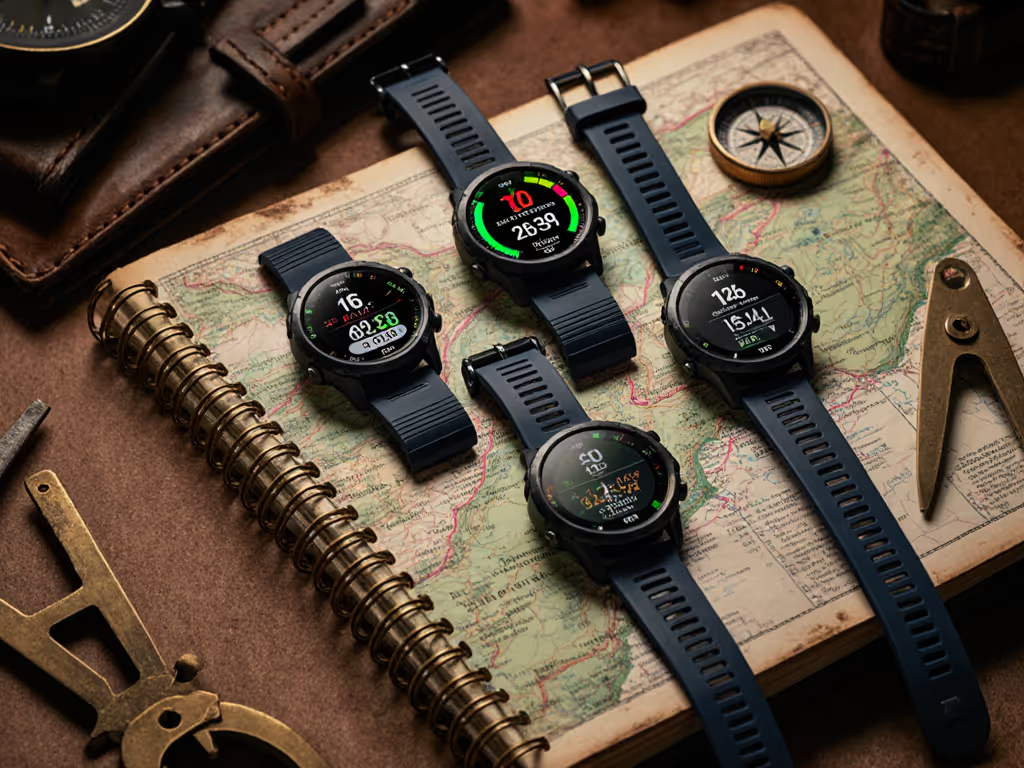
When you compare these ten watches, think in terms of service-life and workflows, not just spec sheets. Here are clear thresholds I use when outfitting teams.
1. GNSS accuracy and modes
- Dual-frequency GNSS is worth paying for if you regularly run under skyscrapers, bridges, or dense trees.
- Multi-constellation (GPS + Galileo + others) improves resilience when parts of the sky are blocked.
- Look for fast satellite acquisition and reliable re-lock after tunnels or pauses - reviewers call this out explicitly in 2026 tests.[1][3][10]
2. Urban trail navigation features
- Full maps (Garmin Fenix / Forerunner 970, Suunto Vertical 2) are best if you like improvising routes on the wrist.
- Breadcrumb + course alerts are usually enough if you pre-plan loops; that covers Apex 4, Vertix 2S, Grit X2, and the mid-tier watches.
- Ensure you can load GPX from your phone in airplane mode - most of these ecosystems now support that, but the details differ.
3. Battery and cold performance
- For pure urban use, a realistic floor is 15–20 hours of GPS; below that, you will charge too often.
- For city-plus-trail weekends or ultra training blocks, target at least 30 hours in your preferred accuracy mode.
- If you race or train in the cold, prioritize platforms known for honest battery behavior in low temperatures (Garmin, Coros, Suunto).[2][3][10]
4. Controls and durability
- Physical buttons should always work without relying on touch; rain and gloves are common on trails.
- Look for sapphire or hardened glass if you spend time brushing past rock and metal railings.
- Standard strap sizes and widely available chargers reduce downtime when something breaks.
5. Data openness and long-term support
- You should be able to export FIT/GPX without a subscription and sync with at least Strava and one planning tool.
- Check the brand's update history: do they keep older models current for years, or abandon them quickly?[2][3][5]
- Map subscription models matter: some brands bundle lifetime maps; others gate premium layers behind recurring fees.
6. Total cost of ownership
When you factor in years of use, spare chargers, bands, and potential map fees, the "cheaper" watch can cost more in the long run. That is why I favor platforms like Garmin, Coros, Suunto, and Polar at the mid-to-high tier: their service-life estimates and support histories are documented and relatively strong.[1][2][3][5][10]
Buy once, cry once.
If you're guiding, doing SAR, or building a multi-year racing calendar, it is cheaper to buy the reliable device once than to replace a marginal one mid-season.
Summary and Final Verdict
If you want one line to act on:
- Best all-rounder: Choose the Garmin Forerunner 970 if you want the strongest balance of urban trail accuracy, navigation, training metrics, and support at a reasonable long-term cost.[1]
- Best value: Pick the Coros Apex 4 if you care most about high accuracy and excellent battery for the money, and you like a lean, open data workflow.[1][2]
- Best mapping tool: Go for the Suunto Vertical 2 or Garmin Fenix 7 Pro if you navigate by map as much as by breadcrumb.[1][3][5]
- Best endurance: Select the Coros Vertix 2S if you routinely stack multi-day city-plus-mountain efforts and want battery to be a non-issue.[1]
- Best smart hybrid: Use the Apple Watch Ultra 3 only if you value smart features first and can live with more frequent charging.[1][4]
Match the watch's support window, battery profile, and data policy to your next 3–5 years of running, not just your next race. The right choice is the one you can keep using, updating, and charging with minimal friction - on pavement, on trail, and far from the nearest store.
Related Articles