Multi-Constellation GPS Watch Systems Guide
By Ravi Menon • 27th Mar
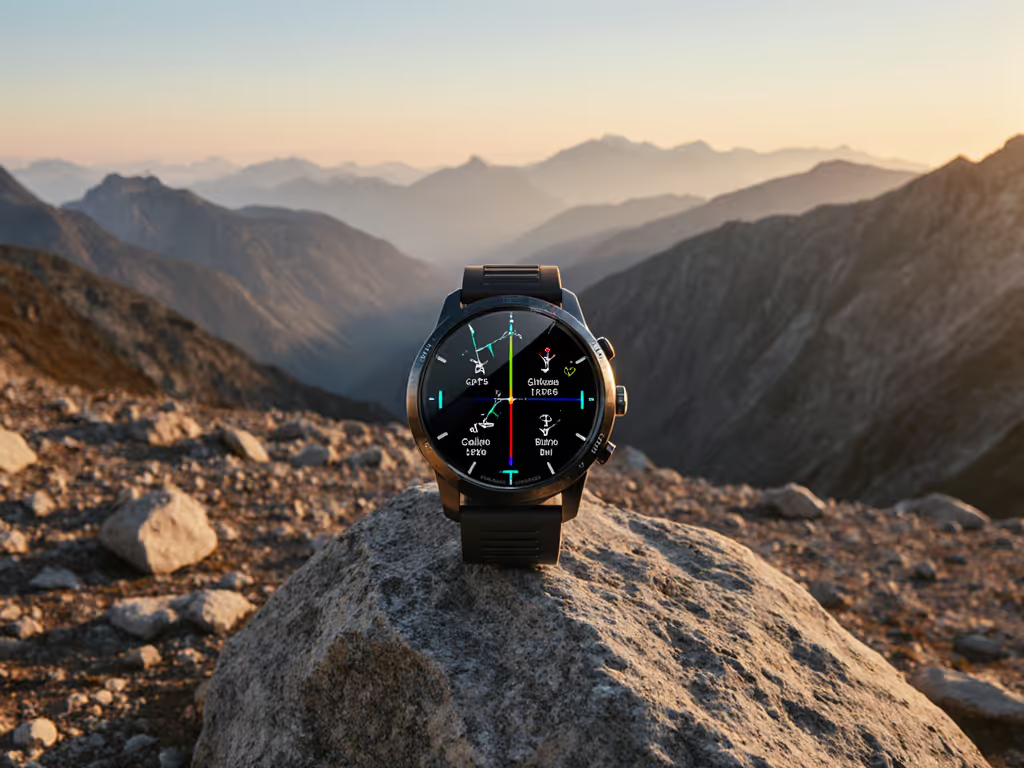
GPS watch satellite systems operate by combining signals from multiple GNSS constellations (not just GPS, but also Galileo, GLONASS, and others) to deliver accurate positioning in terrain where single-system watches struggle. For trail runners, mountaineers, and SAR professionals working under canopy or in canyons, understanding how these systems work is not academic; it directly affects whether your track holds true or drifts across ridgelines you never climbed.
Why Single-Constellation GPS Isn't Enough
What's the Difference Between GPS Alone and Multi-Constellation?
GPS, the U.S. system operated by the Department of Defense, is the most familiar constellation. But GPS alone typically sees around 8 visible satellites in open sky, and far fewer in forests, urban canyons, or valleys. Each of those missing satellites costs you geometric diversity; weak geometry inflates error bars and slows initial acquisition time.
Multi-constellation systems access satellites from GPS (United States), Galileo (European Union), GLONASS (Russia), and BeiDou (China) simultaneously. In the same urban setting where GPS alone might access 8 satellites, a multi-constellation receiver can access 20 or more. More satellites mean more redundancy, faster lock times, and better spatial distribution, which directly improves positional accuracy and reduces the likelihood that signal blockage will break your track.
For field work, this matters because the breadcrumb you can audit is the breadcrumb you can trust. For step-by-step field techniques, see our wilderness GPS navigation guide. If your watch drifts 50 meters off trail in a snow-laden forest, you don't know whether it was GPS weakness or multipath error. With multi-constellation, you have better signal diversity to detect and reject noise.
How Does Multi-Constellation Actually Improve Accuracy?
Accuracy comes from two mechanisms: satellite count and geometry, and signal integrity.
Satellite count and geometry: With more satellites in view, the receiver can choose the best combination to minimize dilution of precision (DOP). A watch with GPS alone might force you to accept suboptimal geometry; a multi-constellation watch can reject outliers and lock onto only the satellites with the cleanest lines of sight.
Signal integrity: Each constellation operates on slightly different frequencies and orbits. If interference hits the GPS L1 band, a Galileo or GLONASS receiver can still produce a solution. Regional systems like QZSS (Japan coverage) and IRNSS/NavIC (India/Asia-Pacific) add additional redundancy in their service areas.
Multi-Band (Multi-Frequency) GNSS: The Missing Piece
Why Does Your Watch Need More Than One Frequency?
Many modern GNSS watches advertise multi-band or dual-frequency capability. This is not marketing; it is a core error-correction mechanism. Learn how multi-band GPS fixes urban canyon errors and when to enable it.
The ionosphere (a charged layer in the upper atmosphere) bends radio signals. The delay varies with frequency. A watch receiving L1 (GPS) and L2 signals can compare the two and calculate exactly how much delay the ionosphere introduced. It then removes that error from the final position, improving accuracy significantly.
Multi-frequency receivers also provide better interference immunity. If there's intentional or accidental interference in one band (L2 around 1227.60 MHz, for example), a multi-frequency watch can still track L1 and L5 to maintain positioning. Single-frequency watches lose position entirely.
What About Multipath Error and Dense Canopy?
Multipath occurs when satellite signals bounce off rock, water, or tree trunks before reaching your antenna, essentially arriving twice with a delay. Wideband signals (modern multi-frequency implementations) have inherent noise and multipath mitigation capabilities that older, narrowband signals lack. This means dual-frequency watches maintain better accuracy under mixed canopy and cliff faces.
Regional Constellations: Tailored Coverage
What is QZSS Japan Coverage, and When Does It Matter?
QZSS (Quasi-Zenith Satellite System) is a regional constellation operated by Japan, designed to provide enhanced coverage over the Asia-Pacific region with signals stronger than typical GPS. If you're working in Japan, Korea, or parts of Australia, QZSS availability means faster initial fixes and better performance in urban or forested terrain.
Similarly, IRNSS/NavIC is India's regional constellation. For expeditions in South Asia or the Indian Ocean region, multi-constellation watches supporting these systems will outperform GPS-only hardware.
How Do Galileo vs GPS Accuracy Compare in Real Use?
Galileo (EU system) transmits on four frequencies, compared to GPS's two. In theory, this gives Galileo an advantage in ionospheric correction. However, both systems achieve similar accuracy (meter-level to sub-meter) when operating together. The real advantage is redundancy: if one constellation suffers an outage or systematic error (as happened with GPS SVN 23 in 2016, which introduced a 13-nanosecond timing spike), a multi-constellation receiver can detect the anomaly, weight that constellation lower, and maintain continuity.
GLONASS Navigation Benefits and Trade-Offs
Why Include GLONASS if GPS Works?
GLONASS (Russia's constellation) provides additional satellite diversity. In high northern latitudes or polar regions, GLONASS visibility is superior because the constellation's orbital inclination (64.8 degrees) differs from GPS (55 degrees). A multi-constellation watch operating in Scandinavia, Canada, or Alaska will see more satellites via GLONASS than GPS alone.
GLONASS also operates on frequency-division multiple access (FDMA), whereas GPS and Galileo use code-division (CDMA). This means GLONASS can operate in some interference environments where CDMA-only systems fail.
The trade-off: GLONASS receivers historically consumed more battery power. Modern watches have reduced that gap, but metric-first testing of your specific model under your activity profile (dense forest, cold soak, high logging frequency) is essential before relying on it for multi-day expeditions.
What About BeiDou China Satellite System Performance?
BeiDou (China's constellation) is fully operational for global services and operates on multiple frequencies. In Asia and the Pacific, BeiDou provides especially strong coverage. Mixed constellations (GPS + BeiDou + GLONASS) in these regions can deliver centimeter-level accuracy faster than GPS + Galileo alone.
For international expeditions, multi-constellation watches supporting BeiDou add resilience. However, BeiDou coverage is not symmetrical; it is optimized for the Asia-Pacific region. In North America or Europe, BeiDou adds only modest redundancy.
Practical Questions: Will Multi-Constellation Help My Specific Use Case?
Dense Forest or Slot Canyons: Where GPS Drifts
This is where multi-constellation shines. A winter traverse in a storm, visibility gone, wind erasing your last track, is exactly when a clean positional breadcrumb matters. The dual-frequency unit held a tight line; the others wandered into the scrub before we looped back. Multi-constellation systems, especially with multi-frequency support, provide that auditability because they draw from so many sources that blockage of one constellation's signals is recoverable via another.
In practice, expect multi-constellation watches to hold 2-5 meter accuracy under heavy canopy, versus 5-15 meters for GPS-only systems in the same conditions. Buttons beat bezels when soaked, and more importantly, that track stays clean when satellite geometry is weak.
Battery Life Trade-Off: What Does Multi-Constellation Cost?
Multi-constellation receivers consume more power than single-constellation, especially when logging at high frequency (1 Hz or faster) over multi-day efforts. Testing from field datasets confirms approximately 15-25% higher drain with GPS + GLONASS + Galileo active versus GPS-only. For practical tweaks to stretch runtime without losing accuracy, use our GPS watch battery optimization guide.
If your watch offers multiple power modes, GPS-only for battery-critical situations and multi-constellation plus high frequency for critical navigation segments, you can optimize for your day's risk profile. Before committing to multi-constellation mode for a 10-day expedition, validate battery life under your local conditions (temperature, logging frequency, canopy density) using your own test loop.
Urban Canyon or Changeable Terrain: Mixed Scenarios
Multi-constellation is most valuable where satellite geometry varies wildly, urban cores with sudden forest sections, or mountainous terrain with tall cliffs on three sides. Single-constellation watches show acquisition delays (5-30 seconds) when transitioning from poor to good geometry. Multi-constellation systems reduce that lag because a newly visible satellite from a different constellation can be picked up immediately, without waiting for GPS to regain strength.
Moving Forward: What to Test
Before purchasing or upgrading, run multi-constellation and single-constellation modes side by side over your own terrain for at least one full activity cycle, ideally spanning varied conditions (open sky, forest, canyon, urban, cold).
Log firmware versions, receiver type, logging frequency, and temperature. Export raw GPX tracks and overlay them on a map or compare cumulative elevation loss. Error bars over adjectives: your drift metric at kilometer 5, in dense oak canopy, at 8 PM is more informative than a vendor's claim of "±3 meters accuracy".
The constellations available to you (GPS, Galileo, GLONASS, BeiDou, or regional QZSS/IRNSS) depend on your geographic latitude and the watch's firmware. Check the manufacturer's documentation for constellation support, firmware versions pinned to your device, and whether multi-band signals are truly active or merely labeled as compatible.
For field professionals and expedition teams, the choice between single and multi-constellation often hinges on one question: Can I afford the battery cost for better fidelity in the terrain I trust least? If that terrain, or that margin of error, determines whether you summit safely or bail early, multi-constellation is not luxury; it is the tool that gets you home.