Bad Weather GPS Watches: Durability, Visibility and Range Tested
By Nadia Okafor • 3rd Mar
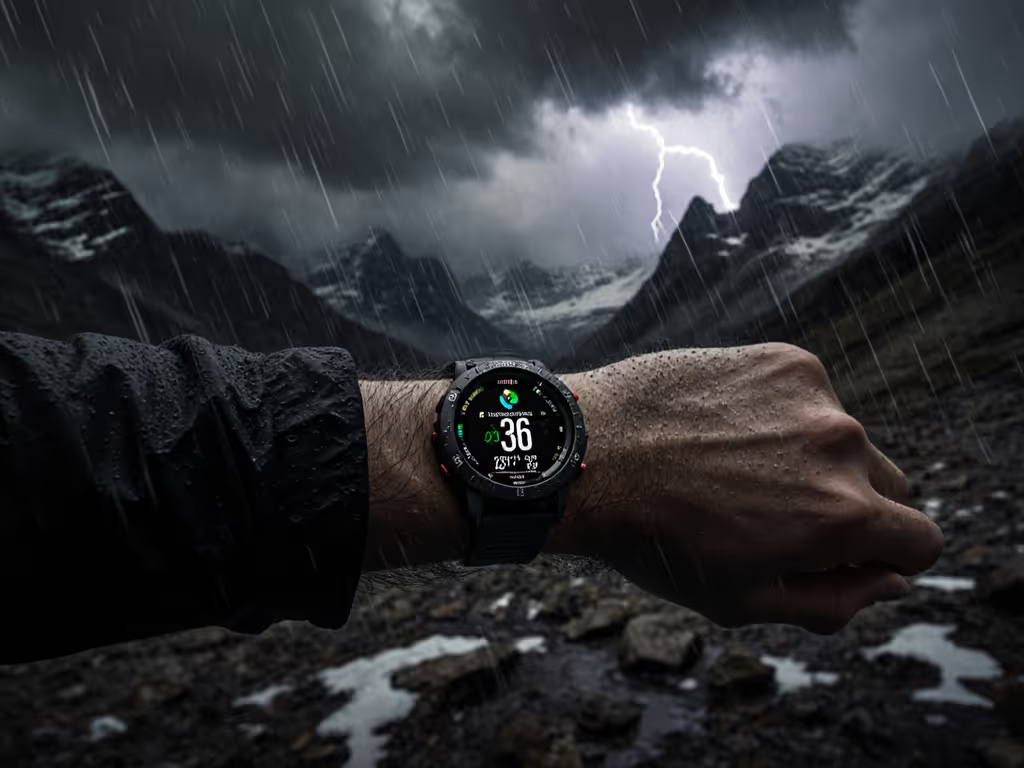
When conditions turn (rain stinging your face, fog collapsing visibility, fingers numb in gloves), your GPS watch's performance in bad weather stops being a luxury detail and becomes the difference between a known route and a lost afternoon. I've watched teams stall not because their watches failed outright, but because they couldn't see the screen in a downpour, couldn't hit buttons with frozen fingertips, or watched GPS signals drift in a canyon while competitors with dual-band systems held steady. That experience taught me to measure watches by what they actually deliver on the trail, not what marketing claims in a lab.
This FAQ distills field-tested data on weatherproof navigation watches, focusing on the features that matter when conditions deteriorate, not when the sun is high and the sky is clear.
What's the Real Difference Between a "Weatherproof" Watch and One That Actually Survives Bad Conditions?
Water resistance ratings tell you only part of the story. A 10 ATM rating means the watch survives 100 meters of pressure (plenty for rain and most water crossings), but it says nothing about touchscreen responsiveness in a rainstorm, fogging behind the lens, or whether the charging port will corrode before the next expedition.
Durability in bad weather hinges on three overlapping factors:
-
Input method and tactile feedback: Touchscreens freeze, stop responding, or register phantom touches when wet or when you're wearing gloves. Button-driven interfaces (especially recessed, rubberized buttons) work reliably regardless. The Coros Vertix 2S uses a button-driven design specifically for this reason; tests show it outperformed other watches in slot canyons and under heavy tree cover, conditions where both GPS signal and manual control are under stress.
-
Lens technology and coating: A bright, scratch-resistant display stays legible in overcast light and heavy rain. Many mid-tier watches use standard glass; premium models like the Garmin Fenix 8 Pro employ AMOLED screens that cut through glare and maintain clarity even in poor light or bad weather. Sapphire crystal (used in the Coros Vertix 2S and Garmin Fenix 7 Pro Sapphire Solar) resists scratches but costs more and slightly reduces touch sensitivity if the watch relies on a touchscreen.
-
Power delivery and charging resilience: Proprietary charging pins can corrode; standard USB or magnetic docks hold up better. A sealed charging door (or magnetic contact) matters on multi-day trips. Battery drain accelerates in cold, especially when using multi-band GNSS to fight through poor signal conditions.
Which GPS Technologies Actually Hold Signal in Bad Weather?
Standard GPS alone struggles in forests, canyons, and heavy precipitation. Multi-band (GPS, GLONASS, Galileo, and often BeiDou or QZSS) and dual-frequency systems (L1 + L5 bands) lock satellites faster and maintain lock under dense canopy or in narrow, high-walled terrain.
In independent trail testing, the Coros Vertix 2S's advanced GPS system delivered measurably better performance in difficult conditions (slot canyons and heavy tree cover) compared to watches using older single-frequency chipsets. The Garmin 570 brings multi-band and multi-GNSS performance to a mid-tier price point, historically a feature reserved for fēnix models; it handles canyons, tree cover, switchbacks, and altitude shifts with impressive consistency.
The trade-off: multi-band GPS drains battery faster. A watch rated for 40 days in smartwatch mode might deliver only 20 to 30 hours in multi-band GPS mode. This is why clarity on which mode you're running, and what runtime to expect, matters far more than a single headline number.
How Much Battery Collapse Should You Expect in Cold Weather?
Cold doesn't just slow a battery; it can halve effective runtime. Lithium-ion performance drops steeply below freezing, especially under high-drain conditions like continuous GPS logging at altitude. Manufacturers rarely disclose cold-weather runtimes; this is a gap in transparency that frustrates field users planning multi-day winter trips. For detailed cold-weather field tests and setup tips, see our winter reliability guide.
The Coros Vertix 2 delivers up to 140 hours of full GPS tracking under standard conditions, an outlier in endurance. Its large battery and conservative power management make it less sensitive to cold drain than lighter watches, though real-world cold-weather runtime is still not publicly benchmarked. The Garmin Instinct 3 Solar, built for extreme conditions down to -22°F, achieves 118 hours in standard GPS mode and 43 hours using dual-frequency GPS (a sharp drop that reflects the power cost of fighting signal loss in harsh terrain).
For pragmatic planning: expect 20 to 30% battery drain in temperatures below 0°C, and more if you switch to dual-band or satellite modes. Don't rely on solar panels in fog or heavy cloud cover; they help in fair conditions but won't rescue you in a multi-day low-light expedition.
What Makes Navigation Usable in Rain and Fog?
A watch with excellent maps, a bright display, and reliable button controls shines when visibility outside is gone. The Garmin Fenix 7 Pro Sapphire Solar includes preloaded maps for over 2,000 ski resorts with impressive topographic detail, and full-color TOPO maps are built in (you can follow trails, check elevation changes, and navigate unfamiliar routes without relying on your phone). Compare map types and get setup tips in our field-tested topo mapping guide.
The Fenix 8 Pro expands on this: industry-leading offline maps with clear detail, a bright AMOLED screen readable even in poor light, and button-driven controls reliable in rain or gloves. For hikers and trail runners heading into remote terrain, built-in satellite communication adds a safety net (send messages, share location, or trigger emergency SOS out of mobile range, though a subscription is required).
But map detail means nothing if you can't see it or interact with it. This is where glove-friendly button controls prove their worth. Once you're in fog or heavy rain, you can't afford to fumble with a touchscreen or squint at a dim display. A watch designed around physical inputs (with tactile feedback and bright illumination) keeps you moving with confidence.
Does Water Resistance Really Mean the Watch Will Keep Working?
10 ATM is the standard for outdoor watches and covers rain, stream crossings, and most water incidents. It does not cover sustained immersion, diving, or high-pressure jets. More critical than the rating is the build quality around seals, buttons, and charging ports.
A titanium alloy casing (like the Coros Vertix 2S) and sapphire crystal resist corrosion and scratching, extending visible lifespan. Recessed buttons prevent accidental presses and keep debris out. A sealed charging door (or a magnetic charging dock that doesn't require open ports) sidesteps the corrosion risk that kills many watches after a wet season of heavy use.
Real durability also means repairability. See our repairability comparison to understand long-term serviceability and total cost of ownership. If a button sticks, can you source a replacement or send it to a service center that stocks parts? Garmin and Coros both support third-party repairs for certain models, but this is not always transparent. Ask before buying if you plan to keep the watch beyond the warranty window.
What's the Real Cost of Ownership After Two Years?
Advertised price is just the entry cost. True cost of ownership includes battery replacement, firmware support, map updates, and whether proprietary accessories (charging cables, watch bands, screen protectors) remain available as components age.
A watch with a non-replaceable battery that degrades after 18 months forces you to replace the entire unit. A watch with open data policies (GPX export, local backups, no mandatory cloud subscription) lets you own your tracks and switch platforms if support ends. A watch with a long historical support window (Garmin's Fenix line often receives firmware updates for 5+ years) protects your investment. See how brands differ in update policies in our software support cycle breakdown.
A $400 watch that requires a proprietary charger, voids warranty on battery replacement, and stops receiving updates after two years costs more over ten years than a $600 watch with a standard USB connection, an authorized service center that replaces batteries for $60, and regular firmware improvements.
Own your tools; don't rent them from a logo.
Renting reliability is still renting. Buy for longevity, repairability, and open standards, and the spreadsheet will thank you.
Which Watch Wins in a Direct Bad-Weather Showdown?
No single model dominates every scenario. The choice depends on your priorities:
For pure endurance and canyon navigation: The Coros Vertix 2S stands out. Its button-driven interface works flawlessly in rain and gloves, dual-frequency GNSS outperforms competitors in slot canyons and dense canopy, and 118 hours of GPS runtime handles multi-day trips without anxiety. At 40 days in smartwatch mode, it frees you from daily charging discipline. The titanium build, sapphire glass, and 10 ATM rating feel like tools designed to last a decade, not a season.
For mapping and breadcrumb confidence: The Garmin Fenix 8 Pro pairs exceptional multi-band GPS, preloaded topographic detail, and a bright AMOLED screen that reads clearly in fog and rain. Battery lasts 40 days in smartwatch mode; satellite communication adds redundancy for off-grid emergencies. The trade-off is a higher price and more complex menus than the Coros. If you're willing to learn the interface, the Fenix delivers authoritative mapping and reliable performance across conditions.
For budget-conscious trail work: The Garmin Forerunner 955 Solar delivers multi-band GPS and solar charging at a lower price point than the Fenix series. At 30 hours standard GPS runtime (extending to 40 with solar, 80 in power-saving mode), it's adequate for day trips and short overnights, though multi-day expeditions require conservative power management. The touchscreen is a weakness in rain or gloves; consider the less-expensive Coros 2X Solar (60 hours GPS battery life) if button controls are non-negotiable.
Final Verdict: Durability, Visibility, and Range in Bad Weather
GPS watch performance in bad weather is not about flashy specs; it's about tactile reliability, honest battery runtime, and clear, readable data when conditions obscure judgment. The watches that survive storms are those built around button inputs, bright displays, multi-band satellite acquisition, and hardware designed for repair and long-term support.
The Coros Vertix 2S excels in field-tested GPS accuracy under canopy and canyon, offers exceptional battery endurance without solar dependency, and uses a button-first interface that never fails in rain or gloves. For expeditions where signal and control matter equally, it's the pragmatist's choice. The Garmin Fenix 8 Pro adds mapping authority and satellite messaging but demands a higher initial investment and more UI overhead.
Regardless of model, verify battery runtime per mode before committing, and don't accept headline figures. Confirm that charging uses standard connectors or magnetic docks, not proprietary pins. Check how many years the manufacturer commits to firmware updates and whether a third-party service center can replace the battery if your warranty expires mid-career.
Bad weather reveals a watch's true design. It's not the features that shine in marketing stills; it's the button you can press with a frozen finger, the screen you can read through spray, and the GPS lock that holds when trees and walls should have defeated it. Choose accordingly, and your watch becomes a tool you trust in the moment it matters most.
Related Articles